USAID DEC
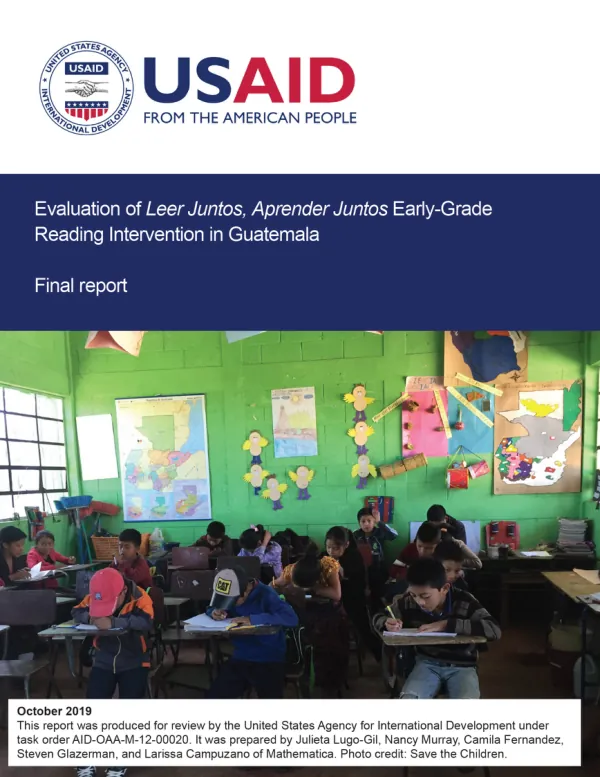
Evaluation of leer juntos, aprender juntos early grade reading intervention in Peru : final report
Sign inMATHEMATICA POLICY RESEARCH, INC.
Evaluation of leer juntos, aprender juntos early grade reading intervention in Peru : final report
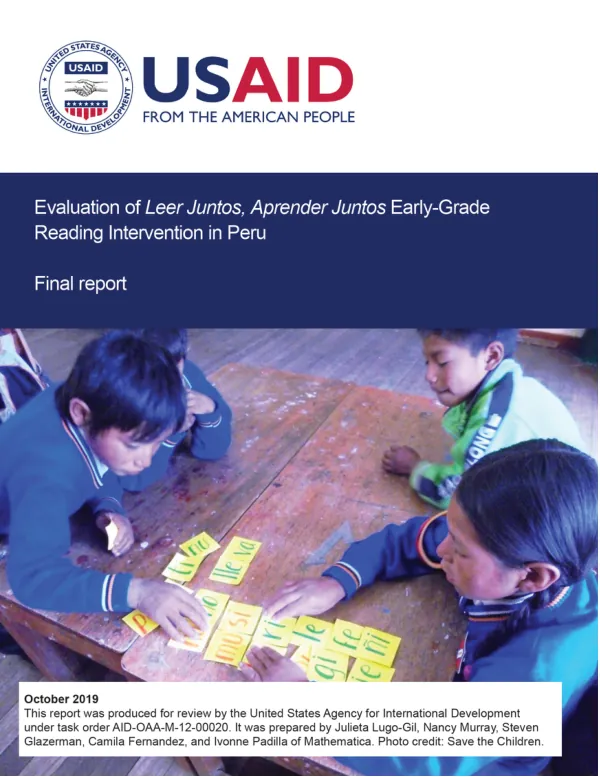
This report estimated the impact of the two main components of Leer Juntos, Aprender Juntos—an early-grade reading instruction program for linguistically diverse communities.
Lugo-Gil, Julieta|Murray, Nancy|Glazerman, Steven|Fernandez, Camila|Padilla, Ivonne · 2019
Sign in to readA free account is required to download.
Abstract
Save the Children developed the program based on its Literacy Boost model and implemented it in Apurímac, Peru. The in-school component aims to train and coach teachers to be better equipped for reading instruction in the early grades. The community action component aims to strengthen parental and community involvement and increase children opportunities to practice reading outside school. We randomly assigned schools to one of three evaluation groups: Group A schools implemented both program components; Group B schools implemented only the in-school component; and Group C schools did not implement the program. To assess the impact of the community action component, we compared Group A with Group B. To assess the impact of the in-school component, we compared Group B with Group C. Within each school, we followed a group of children from 1st grade through the end of 3rd grade. We found a positive impact of Leer Juntos, Aprender Juntos’ in-school component on reading comprehension, and on some, but not all, of the measures on decoding and fluency. The positive impacts were mostly driven by girls. We found no impacts of Leer Juntos, Aprender Juntos’ community component on reading outcomes. Children’s reading skills were similar between schools implementing both program components and schools implementing only the in-school component. We estimated a program cost effectiveness of $136 per 0.10 standard deviation increase in the basic reading comprehension rate.