DEVELOPMENT ALTERNATIVES, INC. (DAI)
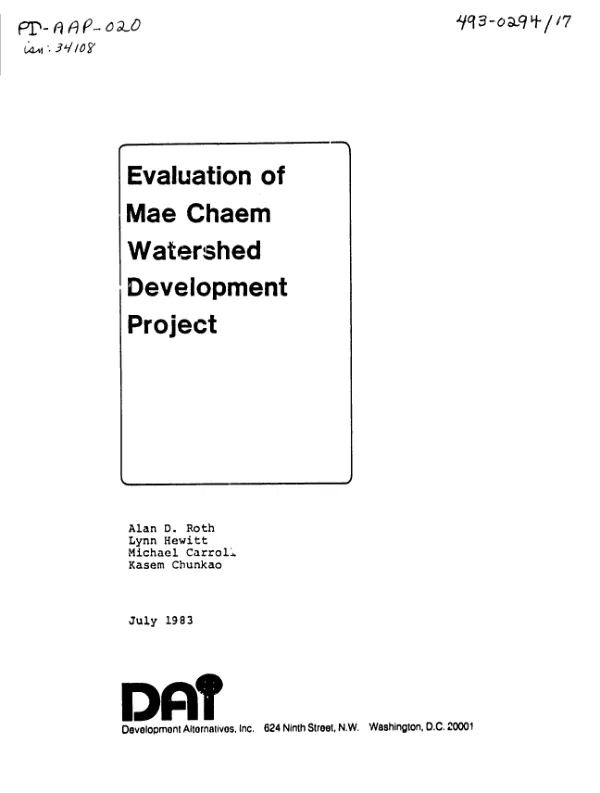
Evaluation of Mae Chaem watershed development project
Evaluates project to increase agricultural production and reverse environmental deterioration in Thailand"s Mae Chaem watershed.
Roth, Alan D.; Hewitt, Lynn · 1983
Sign in to readA free account is required to download.
Abstract
Special evaluation covers the period 8/80-7/83 and is based on interviews with project staff, local officials, fieldworkers, and villagers. Despite the fact that the project took 7 years to plan and is in its third year, very little implementation has taken place. The major reasons for this have been: (1) a freeze on A.I.D. funding for nearly a year, due to the Royal Thai Government"s (RTG) initial failure to meet the condition precedent that it provide land security to farmers on government land who agree to abandon slash and burn farming practices; (2) lack of an adequate management structure to coordinate the work of RTG line agencies; and (3) a slow, cumbersome financial management system. Recently however, considerable progress has been made in developing project management and a field operations strategy. The project"s special interface teams are achieving their purpose of facilitating communication among villagers, project management staff, and RTG line agencies and have worked well with line agency fieldworkers to coordinate their activities at the village level. Although the training provided the teams was appropriate, more technical training would further increase team credibility with villager and RTG officials. With most of the implementation problems overcome, it appears that the project has the potential to preserve the Mae Chaem watershed and provide worthwhile benefits to area farmers. Major recommendations are to: (1) extend the project 2 years to make up for lost time, consolidate it into two phases, and reduce its geographic coverage to only five Mae Chaem subdistricts; (2) focus on encouraging behavioral changes in the local population, which can be facilitated by further training of interface team members, more self-help funding, more rapid implementation of land security efforts, and more efforts to help subsistence farmers gradually move toward farming of cash crops; and (3) improve the coordination of project and line agency staff at the district and provincial levels.
![MANRES [management of natural resources and the environment] assessment : final report](https://covers.devme.ai/gen/6413.webp)