CHEMONICS INTERNATIONAL, INC.
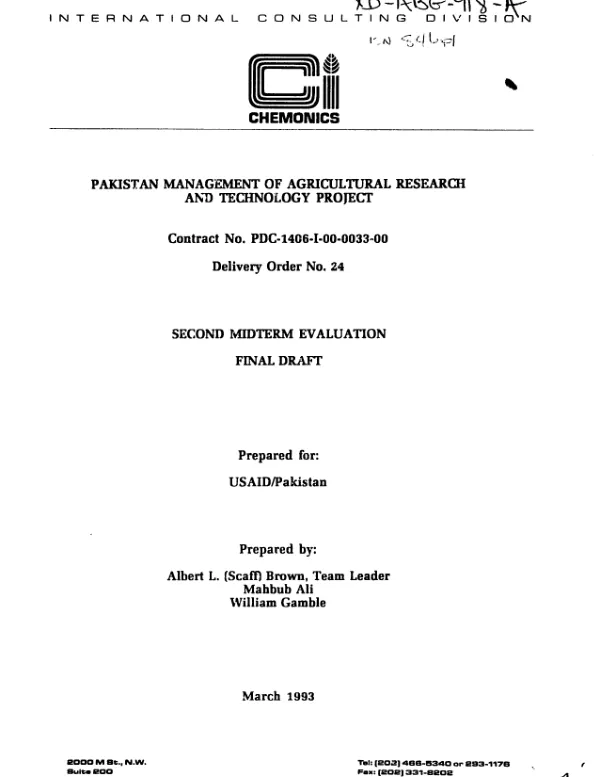
Evaluation of management of agricultural research and technology (MART : 391-0489)
Evaluation of project to strengthen Pakistan's agricultural research system covers the period 1984-2/89.
Ali, Mahbub|Brengle, Kenneth · 1989
Sign in to readA free account is required to download.
Abstract
The project provides necessary support to a national agricultural research system whose products are sorely needed. The project is close to schedule. Most inputs have been delivered on time, and managed to produce programmed outputs. Some delays have occurred in in-country training, which focused more on technical matters than on management improvement. The impact of new elements added by the project, e.g., FSR and communications, cannot be expected until these have been fully integrated, nor can impact be expected from international degree training before the return of the participants. Procurement of laboratory equipment has led to considerable aggravation because of unmet expectations, but other procurement has proceeded without problems. The time required for review and decision on study recommendations was underestimated, however; formal evidence of responsive action is scarce. Otherwise, this project appears to be well managed, on track, and relatively free from implementation problems. Nevertheless, it is very unlikely that planned EOP's will be achieved. Most of the management problems stem from two sources beyond the project's influence. (1) The provinces' independent responsibility for agriculture represents a federal system of research. It is an alliance rather than a controlled organization, so changes must be brought about by consensus, which takes considerable time and effort to develop. (2) Inflexible public sector management systems are not readily modified, even by autonomy; staff are unwilling to risk their careers through innovation. Moreover, the project design is seriously flawed by expectations that are quite unrealistic. Many of the proposed interventions (specifically the systems analyses and many of the convenanted studies) were inappropriate. The indicators of EOP status were presented without baseline or targets. The level of effort allotted to administration was infinitely small in relation to the extent and dispersion of Pakistan's agricultural research system. In addition, the sequencing and timing of interventions are incongruous. Most degree candidates will not have returned to the project long enough for the impact of their training to be felt. Equipment provided in 1988 will have little immediate impact on science. Much of the output of the information transfer component must await the building and equipping of a center and the hiring and training of staff. USAID/P, the Pakistan Agricultural Research Council, and the contractors have nevertheless managed with flexibility to achieve significant progress toward the end of the project. The fact that the project will not reach EOP status by PACD is due more to design problem than implementation concerns. (Author abstract)