UNIVERSITY OF MISSOURI AT COLUMBIA
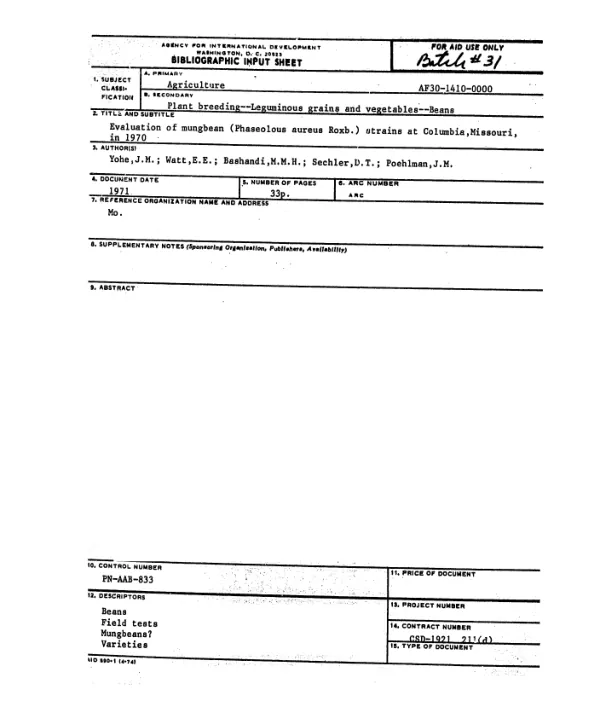
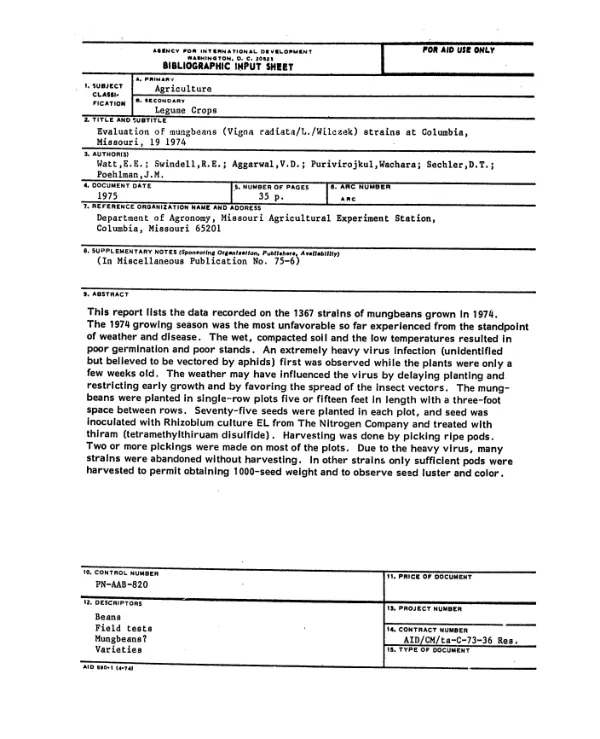
Evaluation of mungbeans (Vigna Radiata/L./Wilczek) strains at Colombia, Mo. in 1974
This report lists the data recorded on the 1367 strains of mungbeans grown in 1974.
Watt, E. E.; Swindell, R. E. · 1970
Sign in to readA free account is required to download.
Abstract
The 1974 growing season was the most unfavorable so far experienced from the standpoint of weather and disease. The wet, compacted soil and the low temperatures resulted in poor germination and poor stands. An extremely heavy virus infection (unidentified but believed to be vectored by aphids) first was observed while the plants were only a few weeks old. The weather may have influenced the virus by delaying planting and restricting early growth and by favoring the spread of the insect vectors. The mungbeans were planted in single-row plots five or fifteen feet in length with a three-foot space between rows. Seventy-five seeds were planted in each plot, and seed was inoculated with Rhizobium culture EL from The Nitrogen Company and treated with thiram (tetramethylthiruam disulfide). Harvesting was done by picking ripe pods. Two or more pickings were made on most of the plots. Due to the heavy virus, many strains were abandoned without harvesting. In other strains only sufficient pods were harvested to permit obtaining 1000-seed weight and to observe seed luster and color.
Connected topics