USAID DEC
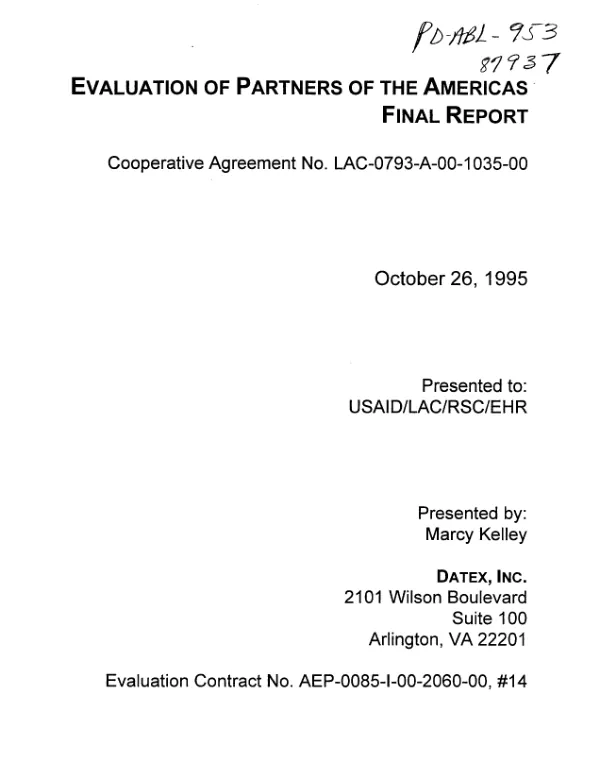
Evaluation of Partners of the Americas, Inc. : final report --: cooperative agreement no. LAC-0793-A-00-1035-00
Sign inDATEX, INC.
Evaluation of Partners of the Americas, Inc. : final report --: cooperative agreement no. LAC-0793-A-00-1035-00
Final evaluation of a project to strengthen the institutional capacity of Partners of the Americas (POA) to promote development in Latin America and the Caribbean by strengthening its partnership organizations and promoting the development of indigenous volunteer organizations.
Kelley, Marcy G. · 1995
Sign in to readA free account is required to download.
Abstract
Evaluation covers the period 5/91-7/95 against a 12/95 PACD. The design of this project, likely the result of POA's evolution from core funding to a cooperative agreement, is overly ambitious and tries to glue together too many disparate interventions in the name of partnership development. The resulting project is a clutter of training, TA, travel, and program grants that are not sustainable and lack clear focus. Thus, while POA has met most of its targets (despite an overall 11% budget cut), it is difficult to show that the project purpose was accomplished. Further, POA has only partially met certain objectives. For example, there has been improvement in reporting but not in self-financing. POA's staff have been consolidated and respond effectively in support of the partnerships, but the regional centers were not strengthened. Instead, in a consolidating and cost-cutting effort, two of the three regional offices were closed. It appears that appropriate and manageable program priorities were not established and this lack of focus has been a limitation to partnership and organizational development. The cooperative agreement was handicapped by a lack of creative leadership both within POA and at USAID. Training opportunities lacked innovative approaches, workshops sacrificed in-depth technical content for breadth of topics, and follow-up and impact evaluation systems were only partially implemented at POA headquarters and not at all in the field. Despite these difficulties, there are highlights. POA partnership representatives have been instrumental in providing continuity to partnerships and supporting them as they undertake new programs and meet POA Standards of Excellence. Face-to-face interactions at training workshops have proved enriching for both the northern and southern partners. Volunteer travel has been another invaluable training arena for both sides of the partnerships, creating programs that build on the strengths of one partner adapted to the reality of the other. POA has been successful at raising other USAID funds to cover some program activities, particularly democratic initiatives and agriculture. In-kind contributions also play an important role in Partners, and the cooperative agreement has generated a four to one in-kind contribution of roughly $13 million. However, the termination of core grant funding at this time moment would result in an overall 10% budget cut for POA, which has not developed alternative funding sources for partnership development activities. It is therefore recommended that USAID provide bridge funding for the next few years to allow POA to replace CA funding with a fee for service strategy in order to reach a certain modicum of self-financing.
Related documents
Documents in this collection
 1995
1995USAID DEC
Evaluation of Partners of the Americas, Inc. : final report --: cooperative agreement no. LAC-0793-A-00-1035-00
Open record 2000
2000USAID DEC