USAID. MISSION TO JAMAICA
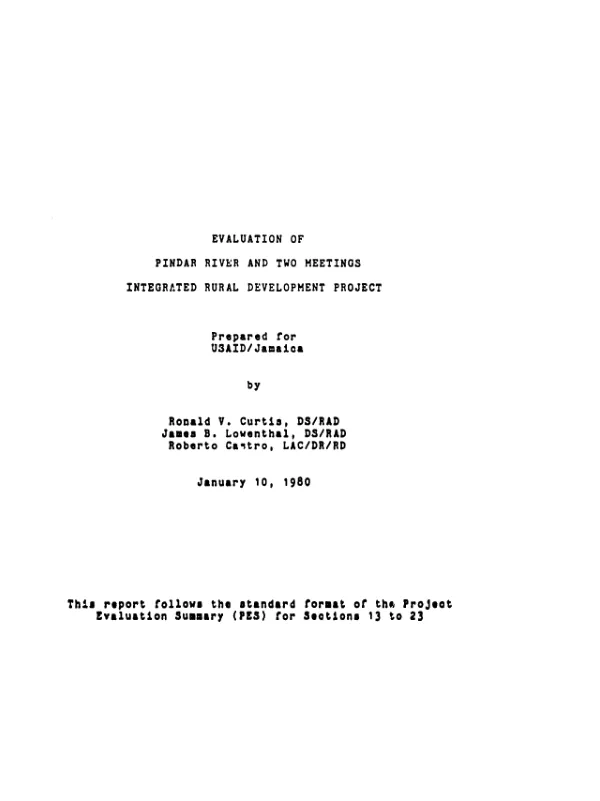
Evaluation of Pindar River and two meetings : integrated rural development project
Evaluates integrated rural development project in two Jamaican watersheds.
Curtis, Ronald V.|Lowenthal, James B.|Castro, Roberto · 1980
Sign in to readA free account is required to download.
Abstract
Special evaluation covers the period 5/79-6/80 and is based on document review, site visits, and interviews with senior project and TA personnel and with farmers. Despite delays due to unseasonable rains and the late arrival of equipment and TA personnel, good progress has been made. In the erosion control component, over 2,000 acres of public and 3,000 acres of private land could be reforested during the life of the project; data on land treatment activities are incomplete. About 30% of farmers in the area have completed plans for soil conservation (SC); 68% of the plans have been approved and 45% are being already being implemented. Staff have adapted well to farmer desires to carry out soil treatment themselves, but this has complicated the issue of farmer contributions to the SC fund. Also, SC costs have been higher than expected. The extension program is weak with regard to the economic returns of different SC methods, partly because research activities (which have focused on cropping systems) have been set independently of extensionists. Construction of infrastructure - electrical lines, housing, roads, and potable water systems - has begun. The farmer organization support component has helped farmers procure credit and has created development committees for farmer involvement, but it lacks a strategy to fully involve small farmer organizations, a failure affecting the project across the board. Regarding training, three long-term participants have been trained in agronomy; 178 others have received short-term training in SC, agricultural credit, and home economics. Because insufficient funds were allotted for TA, several crucial skills have not been available; funds will be exhausted well before project end. Data collection and feedback systems, especially for the farm plans, are inadequate; more attention to farmer traditions is needed. Replication in Jamaica will depend on the degree to which less costly SC methods are found. The implementation strategy should be revised to address developmental goals more directly, with emphasis on strengthening local organizations and the project should be extended to 9/84. Eight other recommendations address the problems noted above.
Related documents