USAID DEC
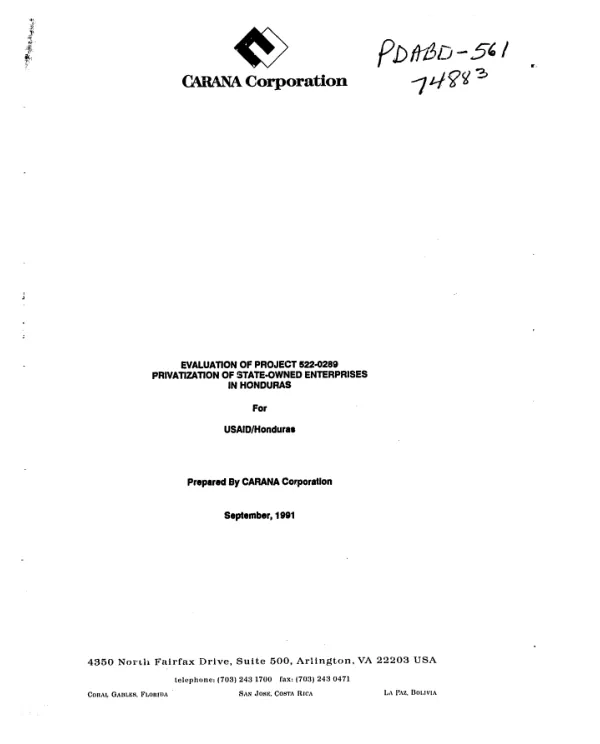
Evaluation of project 522-0289 : privatization of state-owned enterprises in Honduras
Sign inCARANA CORP.
Evaluation of project 522-0289 : privatization of state-owned enterprises in Honduras
Interim evaluation of a project to provide TA to the Government of Honduras for a pilot program to denationalize 12-15 state-owned enterprises (SOE's), especially those of the National Investment Corporation (CONADI).
Landman, Robert S.|Thery, Alain · 1991
Sign in to readA free account is required to download.
Abstract
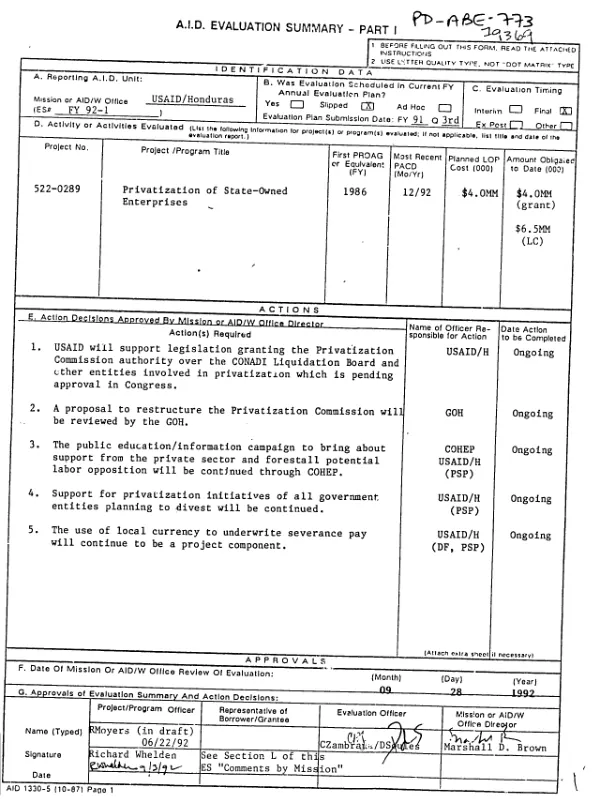
Second evaluation covers the period 3/89-9/91. Since the election of the Callejas administration 18 months ago, the project has stalled, with only one SOE privatized, mainly due to incompetent management by CONADI. The situation is exacerbated by the fact that the administration, despite a stated commitment to privatization, has failed to give the Privatization Commission the legal authority to require CONADI -- which is in effect implementing its own dissolution -- to meet specific deadlines or otherwise impel the other institutional actors involved in the process to comply efficiently with their mandates. There are also growing concerns that the integrity of the privatization process is being compromised by CONADI's refusal to make all pertinent information public. In other ways, the project is working well and to some degree even exceeding original expectations. The project has begun to expand beyond statutorily targeted parastatals to include public service agencies, effectively creating a de facto privatization policy. In addition, the privatization process itself remains intact. The economic benefits of privatization are clear and significant. The project has resulted in the creation of jobs, reductions in the fiscal deficit, increases in export and foreign exchange earnings, and improvements in the balance of trade. While organized labor continues to oppose privatization, it has not been very forceful or effective. In the case of the Ministry of Communications, Public Works, and Transportation (SECOPT), for example, one-third of the workforce was laid off without a major confrontation with the unions. In return, a small number of specific jobs were retained. The use of USAID local currency to underwrite severance pay has proven to be an essential ingredient for success. USAID/H and the implementing agency have maintained a low public profile, which has been effective in establishing the project as a Honduran initiative. The following lessons were learned. (1) Clear and determined presidential leadership and a central management authority are essential for a privatization project to succeed. (2) The political environment is perhaps the most important determinant of the success or failure of privatization. (3) Privatization is a means to economic growth and development, not an end in itself. (4) Severance payments blunt criticism from organized labor and cushion the impact of lay-offs. (5) Not all SOE's can or should be privatized. Some assets are insufficiently attractive for investors and should be shut down to avoid the cost of maintaining them. (6) Data bases on privatization should be kept to track economic benefits. (7) The privatization process should include built-in institutional checks and balances. (8) A central authority empowered to manage the privatization process is essential.
![Small business II project, Honduras : midterm evaluation of the ASEPADE [Asesores para el Desarrollo] component](https://covers.devme.ai/gen/8460.webp)
![Small business II project, Honduras : midterm evaluation of the ANDI/PYME [Asociacion Nacional de Industriales/Pequena y Micro Empresa] component](https://covers.devme.ai/gen/14429.webp)
![Small business II project, Honduras : midterm evaluation of the ANDI/PYME [Asociacion Nacional de Industriales/Pequena y Micro Empresa] component](https://covers.devme.ai/gen/8459.webp)