MANAGEMENT SYSTEMS INTERNATIONAL, INC. (MSI)
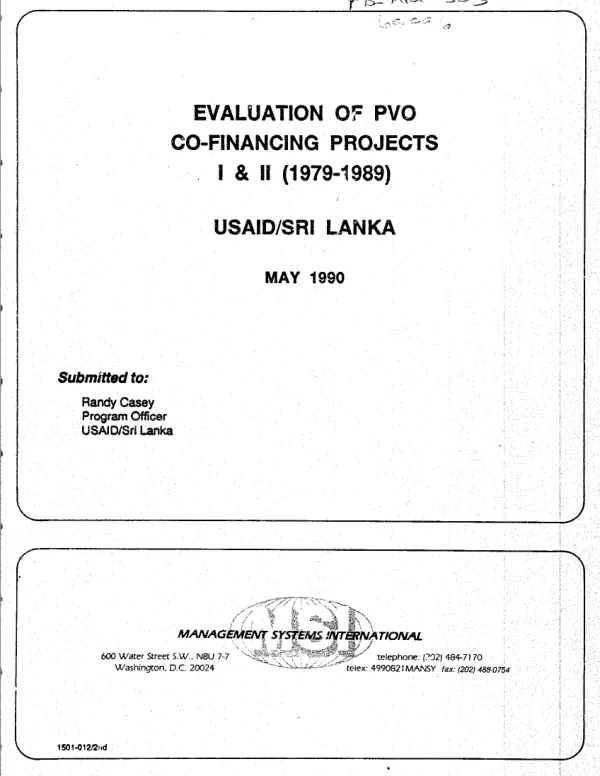
Evaluation of PVO co-financing projects I & II (1979-1989) : USAID/Sri Lanka
Evaluates USAID/Sri Lanka's PVO Co-Financing projects for the period 1979-89.
Barash, Mahlon|Callihan, David · 1990
Sign in to readA free account is required to download.
Abstract
Both projects, Co-Fi I and II, had roughly the same purpose -- to enhance opportunities for local communities to participate in their own development. Co-Fi II, which began ln 1987, put more emphasis on strengthening NGO management capabilities as the means of reaching Sri Lanka's poor majority. Subprojects (SP's) supported by USAID included small-scale agricultural production, savings generation and credit access, family planning services, vocational training, and services for the mentally handicapped. The SP's have had a positive effect on the lives of a significant number of people in need; over 300,000 people benefitted either directly or indirectly. Invariably, those assisted were poor and disadvantaged, as intended. A large percentage of beneficiaries were women. This achievement is all the more significant because the SP's operated during years that Sri Lanka's people and economy suffered greatly from a rapid succession of tragic episodes of violent civil strife. Under the Co-Fi II Project, on which the evaluation team was requested to focus, the Mission has already financed 27 NGO SP's and to a broader range of NGO's than in the earlier project. Diversification of the number and geographic spread of NGO's supported was a particular concern of USAID. The project was also found to be making substantial progress in strengthening NGO management through a major grant to support one of Sri Lanka's most respected and long-established umbrella agencies, the Central Council of Social Services, which has over 80 member agencies. Sri Lankan NGO's are entering a new phase of sophistication and, given the present situation in the country, are in a position to make a large contribution to the country's development. USAID, having invested considerable funds, time, and effort in NGO's, is uniquely positioned to continue taking a key role in the support of NGO's. USAID might have done many things differently and in some cases better over the past 10 years. For example, USAID's monitoring of SP's could have been more systematically handled. In general, USAID has given insufficient attention to formulating a clear overall strategy for its NGO program. Inconsistently applied processes for the selection, design, monitoring, and evaluation of Co-Fi activities were also of concern. The strengths and weaknesses of a range of USAID s Co-Fi activities from the recent past suggest the need for important conceptual and managerial changes. But it is obvious that USAID has already performed a valuable service to the community of Sri Lankan NGO's. Its wide-ranging portfolio of NGO activities has improved the quality of NGO programs in Sri Lanka and increased understanding of the contribution such agencies can make. The evaluation strongly recommends that USAID make a long-term commitment to continue supporting NGO activities in Sri Lanka. The study recommends changes in USAID's conceptualization of its PVO Co-Fi Project. These include: (1) deepening the relationship with the GSL by encouraging line government ministries and its own technical staff to review SP's in their sector of specialty; (2) revising the project's Logframe to incorporate current objectives and reflect monitoring requirements; (3) developing a means to clearly communicate to NGO's the types or themes of activities USAID will consider funding; (4) more thoroughly analyzing SP design assumptions and the likelihood that required inputs can be supplied in a timely manner and in the necessary quantity; (5) considering sustainability according to the following three dimensions: (a) whether beneficiaries can continue activities begun through NGO interventions in the absence of continuing NGO involvement, (b) whether the NGO itself can continue implementing activities similar to those being supported by USAID following the discontinuation of USAID funding (or, in cases of demonstration projects, can pass the activity to either the public or private sector), and (c) whether the NGO itself is institutionally and financially able (with or without USAID funding) to continue its operations over the long-term; and (6) designing and sponsoring, perhaps in conjunction with other donor agencies, a special initiative to support NGO's operating in the North and East. (Author abstract, modified)
Related documents