USAID DEC
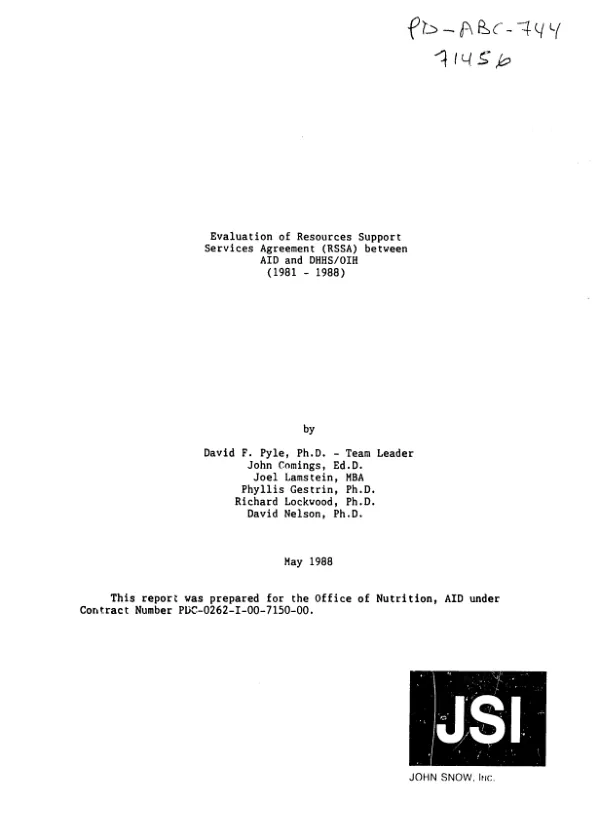
Evaluation of resources support services agreement (RSSA) between AID and DHHS/OIH (1981-1988)
Sign inJOHN SNOW, INC. (JSI)
Evaluation of resources support services agreement (RSSA) between AID and DHHS/OIH (1981-1988)
Evaluates 1981-88 RSSA with the Department of Health and Human Services (DHHS), Office of International Health (OIH), to assist bureaus and missions in the area of nutrition.
Pyle, David F.|Comings, John · 1988
Sign in to readA free account is required to download.
Abstract
RSSA services were provided by a contractor, Logical Technical Services (LTS), a private consulting firm. LTS received core central funding of slightly over $2.3 million from S&T/N, augmented by $1.6 million from regional offices (REDSO/UCA) and bureaus (ANE and Africa), A.I.D. missions, WHO, UNICEF, and UNDP. Most of the personnel involved were regular LTS staff; only a few outside consultants were utilized, primarily because of resource limitations. Generally, the RSSA did, as originally proposed, reinforce and expand A.I.D.'s capability to provide leadership and supporting role in nutrition components in primary health are (PHC) projects. Its greatest achievements were its catalytic and advocacy activities, its systematization of growth monitoring/promotion (GM/P), and its development and promotion of a simple/immediate feedback management information systems (MIS). In terms of outputs, the RSSA produced a large volume of publications (78), provided TA in 20 countries, and carried out operations research (OR) in 8 countries. It also organized and managed 2 major global conferences plus 1 regional workshop and 15 country meetings in 8 countries on nutrition programming issues. The RSSA increasingly focused on GM/P and nutrition surveillance systems (NSS) and, to a lesser extent, on dietary management of diarrhea (DMD) as part of child survival and GOBI (growth monitoring, oral rehydration therapy, breastfeeding, and immunization) efforts. Despite this narrow focus on technical activities, the RSSA effectively promote nutrition activities within A.I.D. missions. It also: generated useful guidelines for GH/P and DHD; served as a catalyst by promoting coordination which led to standardized nutrition activities among PVO's and the Ministry of Health in several countries; developed indigenous skills and institutional capacity; and reoriented GM/P projects from curative to preventative/promotive. On the qualitative side, activities were too narrowly focused on GM/P to the exclusion of other activities mentioned in the RSSA (e.g., nutrition education, supplementary feeding, control of infection, child spacing, infant weaning/breastfeeding, vitamin A and iron). In addition, in several countries OR activities met with little local interest and lacked evidence of how the activities would fit into larger programs. In several cases the RSSA staff had a tendency to take control of local research efforts, thus reducing local participation. There was concern expressed that a RSSA consultant was too directive. In some field activities, GM/P (education and management objectives) and NSS (policy making) were intermingled. The limitation of bureaucracies to implement large-scale, community-based programs was not accorded sufficient attention, raising concern about the sustainability of some of the RSSA activities. The RSSA tended to concentrate on technical details at the expense of larger process issues (e.g., ongoing data collection and processing in the Dominican Republic to the detriment of other important elements such as nutrition education). Though the limited French capability of the LTS core consultants adversely affected their field work in Francophone, West Africa, their fluency in Spanish was a benefit in Latin America. The RSSA was responsive to bureaus and missions and typically provided the same consultant or team over time to a project effort; continuity was mentioned as a strength of the RSSA. In addition, the RSSA was viewed by the bureaus and missions as an inexpensive, easily accessible mechanism to get good quality TA. It proved to be a cost-effective means of providing technical support to missions. The RSSA was not directly involved in service delivery, and, therefore, impact upon nutrition status is impossible to evaluate. But positive effects on service delivery programs (supported through the RSSA) were noted, particularly in the Dominican Republic. The OIH did not act as a service provider but did act as an important facilitator. S&T/N in most cases dealt directly with the contractor. The RSSA did not, therefore, fully satisfy A.I.D.'s desire to broaden its support or reduce its administrative load. The OIH provided considerable support to the RSSA contractor (e.g., communications, publications, library) and kept the project going for extended periods when the RSSA had officially lapsed. It also monitored RSSA "deliverables" and did most of the RSSA budget analysis and projections. The evaluation team recommends that S&T/N design a new project in which the goals and implementation mechanism are more clearly defined. The project should be a direct relationship between S&T/N and a contractor. The new project should take the form of a nutrition-in-health service delivery/support project having a broad focus, maintaining the primary goal of promoting nutrition in other health efforts. As with the RSSA, services should be easy to procure, and the maximum continuity of TA personnel for each task should be encouraged. The project should have central funding to begin work and be designed in such a way that local missions and regional bureaus, as well as UN organizations, other governments, and PVO's, could buy into the project. From the experience of this project, OR might be left to existing projects such as PRICOR, but in general, missions and bureaus can be expected to be specific about their requests for help. (Author abstract, modified)
Related documents