USAID DEC
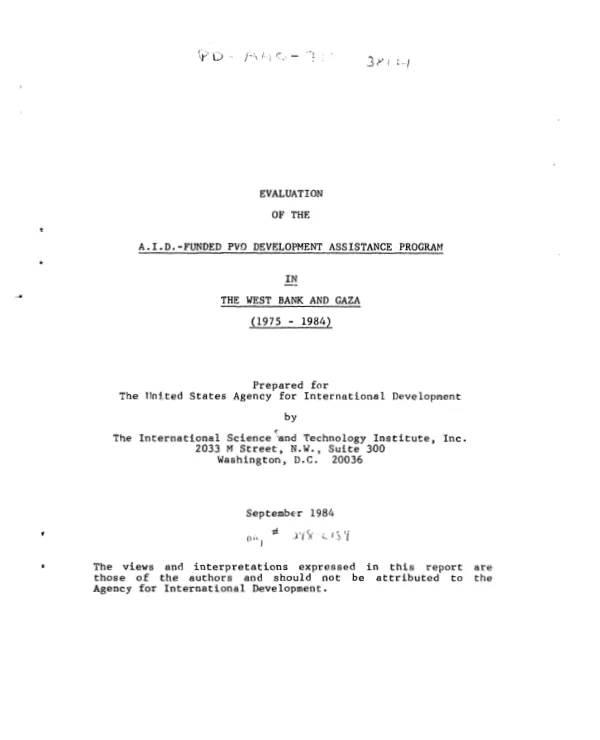
Evaluation of the AID funded PVO development assistance program in the West Bank and Gaza, (1975-1984)
Sign inINTERNATIONAL SCIENCE AND TECHNOLOGY INSTITUTE, INC. (ISTI)
Evaluation of the AID funded PVO development assistance program in the West Bank and Gaza, (1975-1984)
Evaluates five PVO projects in the West Bank and Gaza.
1984
Sign in to readA free account is required to download.
Abstract
Special evaluation covers the period 1975-84 and is based on document review, site visits, and interviews with officials and staff. The projects have reached about 50% of the people in the West Bank and Gaza, fulfilling their goal of showing U.S. concern for the Palestinian people. Dedicated and seasoned PVO field personnel - both expatriate and Palestinian - are the major factor in the projects" success, accomplishing seemingly impossible tasks in a tense political environment. Catholic Relief Services (CRS) Rural Development Projects I and II are excellent participatory, community-building programs. Subprojects (roads, water, primary schools, community centers, clinics) were all completed, needed, wanted, used, maintained, and relevant to village needs. The Community Development Fund (CDF) Rural Community Development Project II is the strongest agriculture project and the only one staffed by senior agriculturalists. CDF has the largest and most diversified water program (rural and urban, drinking water, wastewater disposal) and the only AID-supported preschool program in villages and towns; it aids, inter alia, a blood bank, a school for the mentally retarded, and dental and eye clinics. Holy Land Christian Mission International (HLCMI) operates preschools for 5-yr-old children in refugee camps in the West Bank and Bethlehem, and a Mothers In-Home Program for 4-yr-olds. Both are well received and considered very beneficial, as are similar activities in Gaza. The America Near East Refugee Assistance (ANERA) Project is active in vocational training, agricultural production and cooperatives development, health, and water and sanitation; 71 of 108 subprojects have been completed, 5 are underway, and 32 (most in agriculture or income generation) have been disapproved or tabled by Israel for political or security reasons. The America-Mideast Educational and Training Services (AMIDEAST) Human Resources Development Project has provided U.S. training for 181 faculty in 7 institutions, scholarships for 995 undergraduates at West Bank universities, and short-term U.S. training for 100 persons from the development community, as well as other assistance in the educational sector. Recommendations include to increase assistance, especially in Gaza.
Related documents
Documents in this collection
 1984
1984USAID DEC
Evaluation of the AID funded PVO development assistance program in the West Bank and Gaza, (1975-1984)
Open record 1984
1984USAID DEC