USAID DEC
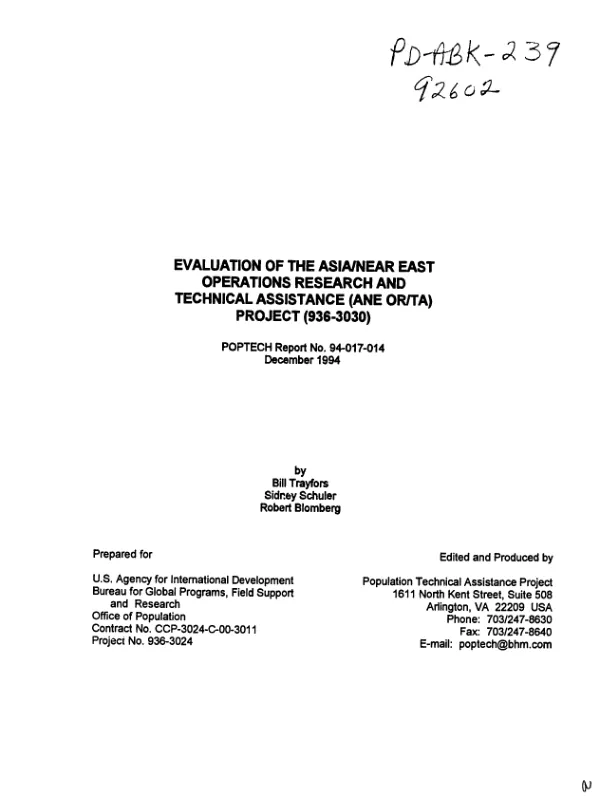
Evaluation of the Asia/Near East operations research and technical assistance (ANE OR/TA), project (936-3030)
Sign inBASIC HEALTH MANAGEMENT INTERNATIONAL (BHM)
Evaluation of the Asia/Near East operations research and technical assistance (ANE OR/TA), project (936-3030)
Evaluates activities in Asia and the Near East in a project to provide TA in operations research (OR) to improve family planning (FP) services.
Trayfors, Bill; Schuler, Sidney +1 more · 1994
Sign in to readA free account is required to download.
Abstract
Evaluation covers the period 7/90-8/94 and is based in part on interviews with over 100 persons. Project performance in terms of quality and impact was generally weak during the first three years, but strong during the fourth year, and the fifth year looks highly promising. All contract deliverables will be completed by project end, with 18 subprojects already completed, and 26 underway vs. a target of 30-35; 20 workshops have been held vs. a target of only 8. The project"s emphasis on providing TA outside of the context of formal OR studies appears to have increased the perceived value of the OR program to USAID Missions and has made easier for OR advisors to assist service providers and policy makers. The broadness and flexibility of the contract scope of work made it important to develop both a clear overall strategy and specific country strategies. The former is still lacking, but country strategies were in place by the time of the evaluation. In the three most populous South Asian countries (Pakistan, India, and Bangladesh), it appears that the project is now strategically positioned to have a major impact. While the project has succeeded in providing well-focused TA to researchers in at least two countries, in other cases TA and training have been more scattered and seem to have been less effective. More researchers could have been given opportunities for participatory OR training if this had been made an explicit goal. Dissemination of research findings have been limited, but should increase dramatically under a new and thoughtful dissemination plan. Given the time frame of the project and the nature of the subprojects, the impact of the project can only be measured by intermediate indicators, not by measures such as change in contraceptive prevalence. More often than not, the subprojects have generated findings that provide decisionmakers with information about what not to do, rather than what to do, although this information has affected significant decisions. In several countries, the project seems to have been quite effective in imparting the concept of OR to program managers and decision makers. While its documentable impact has been modest, the project has the potential to achieve a substantial positive impact on FP services, particularly since the contractor has developed an institutional presence in the area and has gained host government clearances and opened field offices.