USAID DEC
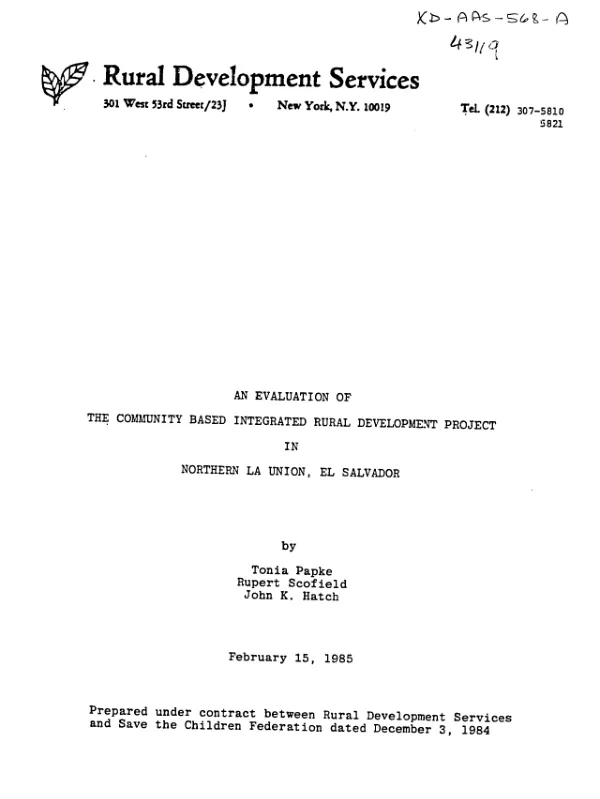
Evaluation of the community based integrated rural development project in Northern La Union, El Salvador
Sign inRURAL DEVELOPMENT SERVICES
Evaluation of the community based integrated rural development project in Northern La Union, El Salvador
Evaluates community-based integrated rural development project in the municipalities of El Sauce and Concepcion de Oriente in El Salvador.
Papke, Tonia|Scofield, Rupert|Hatch, John K. · 1985
Sign in to readA free account is required to download.
Abstract
Final external evaluation covers the period 9/79-12/84 and is based on document review, site visits, and interviews with Save the Children Federation (SCF) personnel and community leaders. The project has been successful in meeting the basic needs of both the target population and large numbers of indirect beneficiaries, especially given the unfavorable political, economic, and environmental conditions prevailing in the region. The formation of grupos solidarios has been a key factor in increasing the availability of agricultural credit and inputs which has led to a 100% increase in crop yields and a 20% increase in acreage planted; farmers' net adjusted income has approximately doubled since 1982. Family health and nutrition (especially of children) have improved significantly due to the increased availability of grain and to project activities such as health and nutrition education, family gardens, vaccination, and deparasitization; child mortality in Concepcion de Oriente decreased from 18 in 1980 to 0 in 1984. Educational activities (e.g., classroom construction, promotion of school clubs) have led to increases in school enrollment and student promotions and a marked decrease in the dropout rate; in addition, 113 adults have been taught by volunteers to read and write. Cottage industry development was the only unsuccessful project component. The project has had one major shortcoming. Although SCF has trained competent community leaders, mobilized volunteers (their turnover is high, however, due to lack of incentives), and formed various ad hoc community committees, it has failed to create self-sustaining community-level institutions which can carry on project functions. It appears that four municipal committees formed by SCF have been strengthened at the expense of - or in lieu of - strong and permanent community-level organizations. SCF's project management, in general quite effective, was deficient in the areas of reporting and program evaluation. Several recommendations for a follow-on project are made.
![Dori integrated rural development (PVO, OPG) [PES - A1, F1]](https://covers.devme.ai/gen/12122.webp)