CARGILL TECHNICAL SERVICES, INC.
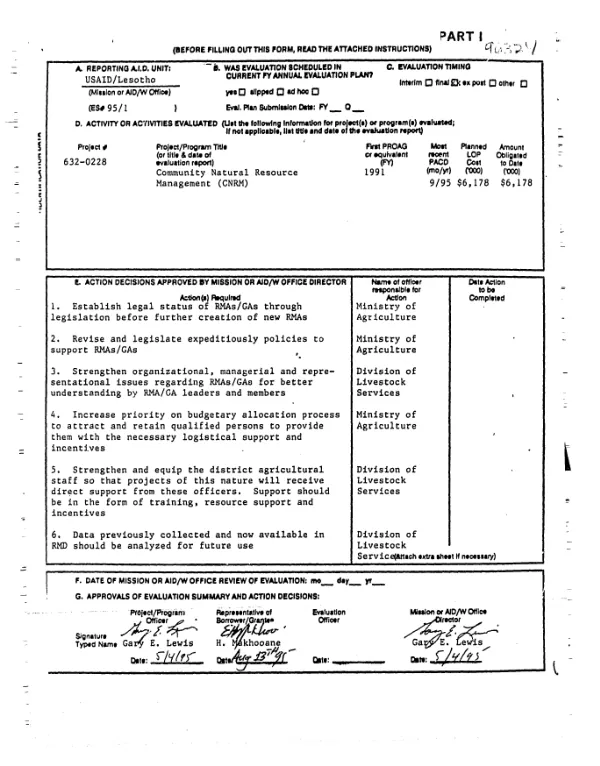
Evaluation of the community natural resource management (CNRM) project : Lesotho
Final evaluation of a project to improve the management of rangelands in mountainous areas of Lesotho through development of community grazing associations (GAs).
Jackson, Donald R.; Conje, John · 1995
Sign in to readA free account is required to download.
Abstract
The evaluation covers the period 6/91-4/95. The project"s purpose and many expected outputs were not met due to factors beyond the project"s control -- especially the 6/93 decision to close the USAID Mission in Lesotho and end the project by 9/95, the unfavorable political environment in which the project existed, and the weakening of the Division of Livestock Services due to termination of the Lesotho Agricultural Policy and Support Project (LAPSP). Nonetheless, the project"s long-term advisors performed remarkably well, and while long-term training was canceled, over 300 person-months of short-term training in diverse topics were provided to Ministry of Agriculture (MOA) staff and GA and Range Management Area (RMA) members. The Government of Lesotho (GOL) will need to quickly revise, approve, and implement its natural resource management (NRM) policies so as not to jeopardize the future of the entire RMA/GA program. With the technical issues surrounding the RMA/GAs fairly well understood by RMA/GA leaders and members, organizational, managerial, and representational issues should now be given priority. The viability of the GAs has in particular been put at risk by the cancellation of the National Grazing Fee, which would have provided the GAs with a financial base, and by the challenge to the GAs" legal status in the courts. Additionally, while women benefited from some of the project"s activities, more remains to be done to include them in NRM programs. The vast majority of rural Basotho have no economically viable investment opportunities other than livestock. On a technical level, the issue of overstocking of rangelands should be given priority. The following lessons were learned. (1) Project designs should be based on realistic assumptions as to what can be accomplished in a reasonable timeframe given national and local sociopolitical and administrative structures. In this regard, the Logical Framework Matrix should be effectively employed in both the project design and evaluation phases. (2) Long-term projects must be designed with sufficient flexibility to account for changes in the local political, economic, and social environment. (3) Missions with limited resources can incorporate NRM into development activities; USAID/L"s experience provides valuable insights in this area. (4) Host government support, especially in the area of policy directives, is a prerequisite to developing the necessary long-term strategies to address NRM issues. (5) A favorable political climate is critical to the acceptance and performance of NRM projects. (6) Premature truncation of a project results in violation of the principles of sustainability, proper planning, and economic efficiency in project implementation.
![End of program evaluation report (Nov 1999-Oct 2002) : cooperative agreement between USAID and WWF [World Wildlife Fund] Indonesia no. 497-A-00-00-00002-00 -- the Outer Islands bioregional program : integrated protected area management and spatial planning in Kalimantan and Papua[, Indonesia]](https://covers.devme.ai/gen/5324.webp)