CARE INTERNATIONAL
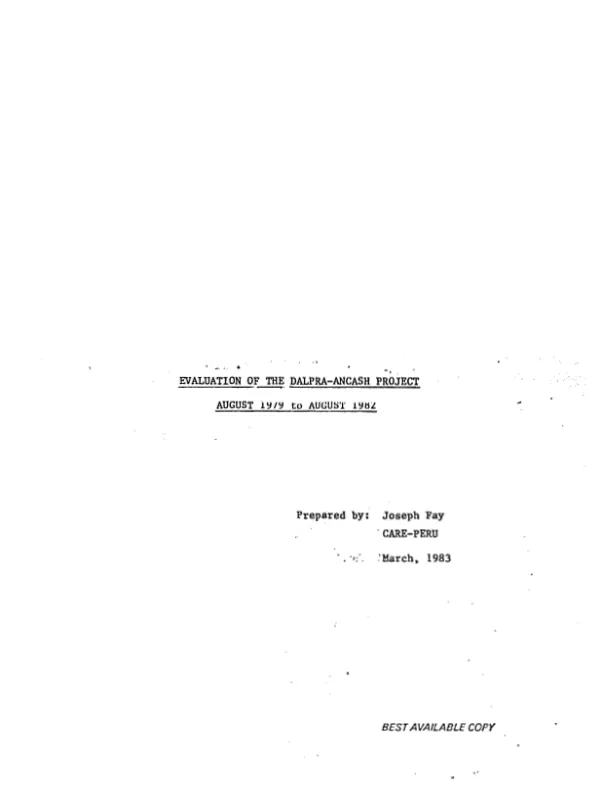
Evaluation of the DALPRA - ANCASH project, August 1979 to August 1982
Evaluates project to improve nutritional status and food production among campesinos in Peru"s Ancash Department.
Fay, Joseph · 1983
Sign in to readA free account is required to download.
Abstract
Special evaluation covers the period 8/79-8/82 and is based on document review. The project has been implemented in 9 communities, with 542 families as direct beneficiaries. Priority has generally been given to food production. Production of seed potatoes has been very successful, and will ultimately reduce farmers" dependence on seed wholesalers and reduce their needs for cash. Development of seed banks should be a principal goal of future project activities. Although data are lacking on the production levels of other crops, cost-benefit ratios were evidently good for most crops, and especially so for cob corn. Little training in marketing strategies was provided to farmers, due to lack of trained staff in this area. An agricultural economist should be contracted to either train project staff or work directly with farmers and communities. In the latter case, the project, rather than providing farmers with all necessary inputs in exchange for 50% of their harvests, would finance inputs through a loan which farmers would repay after marketing their produce themselves. Regarding the nutrition component, the communal dining rooms were not accepted by beneficiaries and were closed at the beginning of the fourth year. An alternative strategy, focusing on nutrition education among existing work groups, was developed and has been well-received, although in general nutritionists" inability to speak Quechua fluently has limited nutrition education. Family gardens have been enthusiastically initiated in most communities; savings realized by the closing of the dining rooms should be utilized here. Also, expansion of the nutrition program to include training in health promotion and disease prevention should be formalized with the Ministry of Health. There have been a number of management problems, e.g., lack of clear delineation of responsibilities among field staff, creating confusion internally and for beneficiaries as well; different employee benefits policies on the part of CARE and the National Office of food Support (ONAA), which hindered personnel administration; and the need to satisfy the reporting requirements of A.I.D., CARE, and ONAA.
![CARE Peru : midterm evaluation -- child survival project XVI : FAO-A-00-00-00036-00 [i.e. FAO-A-00-00-00030-00] -- October 1, FY2002-September 30, FY2004 : project REDESS, 'health and social networks'](https://covers.devme.ai/gen/5307.webp)
![CARE Peru : midterm evaluation -- child survival project XVI : FAO-A-00-00-00036-00 [i.e. FAO-A-00-00-00030-00] -- October 1, FY2002-September 30, FY2004 : project REDESS, "health and social networks"](https://covers.devme.ai/gen/43867.webp)