INTERCULTURAL COMMUNICATION, INC.
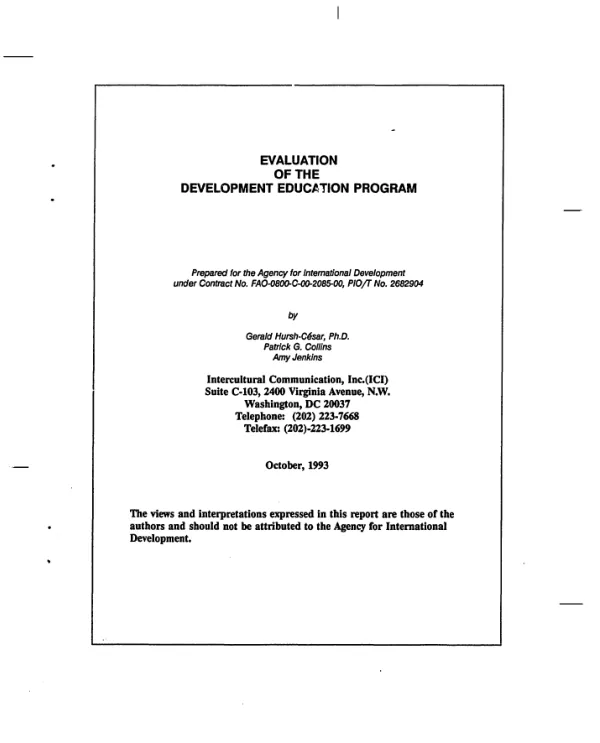
Evaluation of the development education program
Evaluates project to increase public awareness of development issues and strengthen the professional capability of organizations involved in development education.
Hursch-Cesar, Gerald|Collins, Patrick G.|Jenkins, Amy · 1993
Sign in to readA free account is required to download.
Abstract
Evaluation covers the period 1982-10/93. The project has made significant strides toward increasing awareness of development issues within the American public and has made certain, but unsteady, strides toward strengthening the field of development education. The size and types of audiences reached by the project are difficult to measure due to insufficient feedback from grantees; however, a conservative estimate is that 37 million people have been reached at least once. Grantees have done a good job of targeting and reaching the kinds of leadership, practitioner, and group audiences intended for the program. Targeted audiences were found to be knowledgeable, articulate, influential, and active in their communities, and are considered likely activists for promoting wide, lasting impact. Grantees have also done a good job of focusing on the primary development issues of global interdependence, hunger, poverty, and the key roles of agriculture and the environment. Audiences have been most receptive to themes of global interdependencies among nations, and the humanitarian responsibility of the United States to help other nations, including the provision of economic assistance; and least receptive to the message of helping others before solving our domestic problems, the idea that root causes of Third World hunger and poverty are the same as in the United States, and that aid can be effective in dealing with poverty, population growth, and environmental conditions. To the project's credit, development messages have been diversified, and have changed over time to reflect shifts in A.I.D. policies. On the negative side, however, at times these message have been one-sided, lacked substantiation, and included weak recommendations for follow-up action. Grantees' programming approaches have varied. About three-fourths of the grantees have tried overtly to change public attitudes; fewer than half have encouraged public involvement in Third World issues, programs, or causes. The diverse mix of the grantees selected through open competition is most often seen as the program's greatest strength. The program's greatest weakness is lack of an overall plan (consisting of consistent objectives, themes, activities, and information products) by which grantees' performances can be evaluated. Lessons learned in this area include the need of grantees to have the support of their parent institutions, the need to monitor audience reach, and the need to conduct more thorough and more frequent self-evaluations and improve reporting and information dissemination. Development education is a new field, and one result of the diversity among grantees has been a high degree of innovation. However, mechanisms for replicating these innovative programs are lacking. Chances for project sustainability are mixed: generally, grantees that were already involved in development education prior to project support will continue to work in this field, perhaps using skills newly learned under the project; grantees that were not involved prior to a project usually do not continue after it. Finally, the program has been a catalyst for development education efforts nationally, and has contributed to the growth of an informal, often local professional network, as well as a national network (which, however, remains small). The best mix of organizations to increase impact would be many of the same organizations in the field now, but with improved guidance and stronger, explicit contract requirements.