USAID DEC
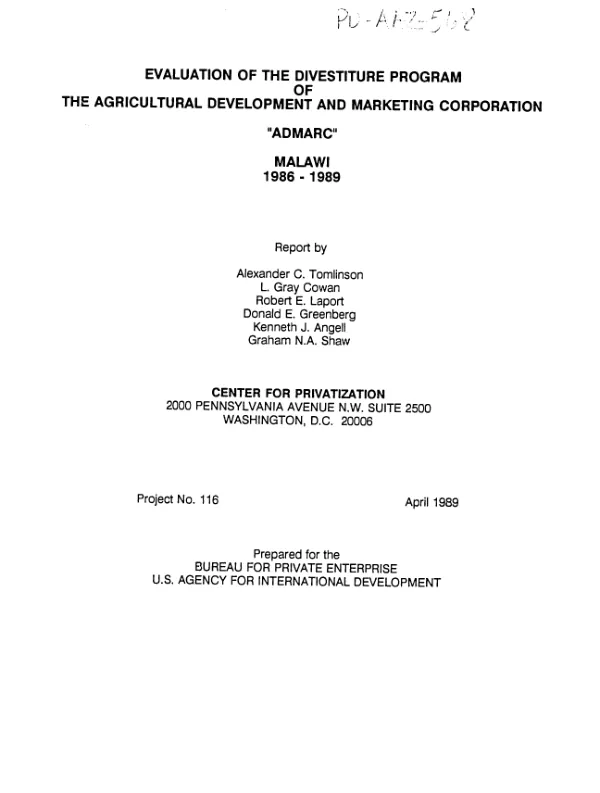
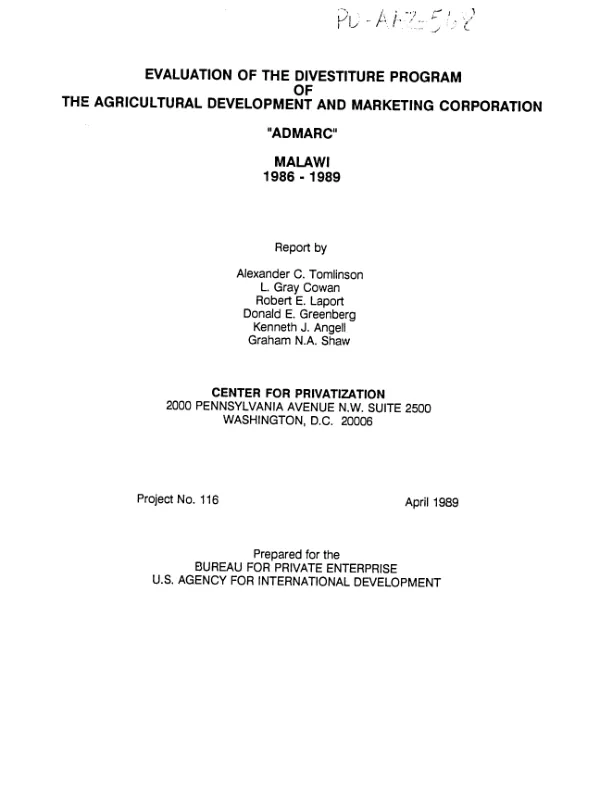
Evaluation of the divestiture program of the Agricultural Development and Marketing Corporation, `ADMARC,' Malawi, 1986-1989
Sign inCENTER FOR PRIVATIZATION
Evaluation of the divestiture program of the Agricultural Development and Marketing Corporation, `ADMARC,' Malawi, 1986-1989
Interim evaluation of a project to help the Agricultural Development and Marketing Corporation (Admarc), a Malawian parastatal, restore its liquidity through the divestiture of assets valued at MK 47 million.
Tomlinson, Alexander C.|Cowan, L. Gray · 1989
Sign in to readA free account is required to download.
Abstract
External evaluation covers the period 1986-3/89. Divestiture has proceeded relatively rapidly, and Admarc's liquidity, as well as its ability to carry out marketing functions, has visibly improved. Since work began about 2 years ago, 9 estates and 3 companies have been sold and sales of a further 7 estates are in progress. The aggregate value of assets divested totaled MK 34.6 million, of which Admarc received MK 14.7 million in net cash proceeds. These achievements have been made despite severe constraints to divestiture in Malawi, namely the lack of a developed capital market and the very small number of potential buyers with sufficient capital. Although a commendable effort has been made to identify new buyers and involve smaller purchasers, many sales represent a continuation of the concentration of ownership, with potential for abuse of monopoly power. For example, the Press Group, Malawi's largest enterprise, has been a major purchaser of Admarc assets. In many cases at least a partial share of these assets could have been sold to other buyers. Moreover, a reluctance to sell to resident Asians has precluded access to an important source of capital and management expertise. Due to the lack of conditionality, USAID/M has been limited in its ability to impose or influence divestiture objective or standards. Government of Malawi (GOM) officials are generally satisfied with the TA provided by the project and the progress to date in divestiture. Although the GOM has insisted in some cases on keeping a minority interest in properties, there is growing enthusiasm among officials for private sector growth and the prospect of other privatization projects. It is recommended that the current project be extended for a year with continued TA, provision of financial incentives (e.g., balance of payments support), and possibly additional funding from other donors to support the establishment of a unit trust or local currency liquidity line of credit. Thus far, USAID/M has provided the GOM with $11.55 million in balance of payments support, while a further $3.45 million is expected to be disbursed before 6/89. Several lessons were learned. (1) Strong commitment at the top of government is crucial to success. (2) A systematic approach to the divestiture process can contribute materially to effectiveness. (3) Divestiture can be most effective and least controversial when undertaken in the context of solving a problem (e.g., lack of liquidity). (4) Valuation is less likely to be a problem when specific business and economic goals are the focus of a privatization program. (5) Missions can materially assist the divestiture process through provision of TA and an incentive.
Related documents