USAID. MISSION TO EGYPT
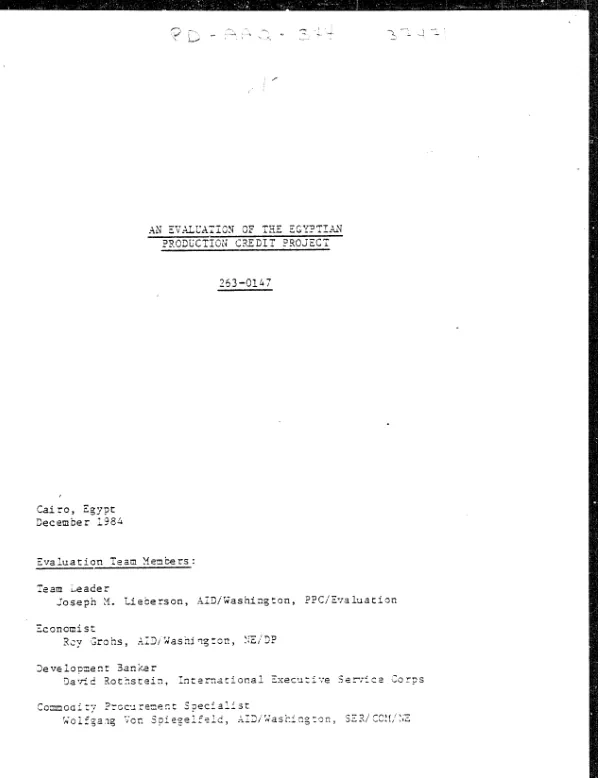
Evaluation of the Egyptian production credit project
Evaluates project to provide foreign exchange (FX) imports and short-term credit to Egypt's private sector and to upgrade Egypt's credit system.
Lieberson, Joseph M.|Grohs, Roy · 1984
Sign in to readA free account is required to download.
Abstract
Special evaluation covers the period 8/82-12/84 and is based on document review and interviews with host government, bank, private sector, and USAID/E personnel. Although project goals were overly ambitious, FX inputs were successfully provided to private industries that use these efficiently. The project expanded on a previous Commodity Import Program (CIP) credit effort by including 4 private banks as well as Egypt's 5 public banks and by creating a demand-based system ($3m in project funds were allocated to each bank and the remainder distributed to banks able to move their funds), thus encouraging competition and rewarding efficiency. Private banks' share of transactions was smaller than had been hoped, but their rate of participation did reflect their fair share of the banking market. As of 12/9/84, transactions worth $54m (80% of the program) had been approved and $37m (55%) issued in credit; all funds should be allocated by 2/85 and disbursed by 10/85 (vs. a goal of 3/85). To diffuse funds among a wide range of companies, transactions were limited to $500,000 (8 exceptions occurred) and total imports per firm to $1m/year. The development value of only 3 or 4 (vs. a total of 288) transactions was questioned, and as 68% of transactions were with end users, the trader windfalls which occurred under the CIP have been virtually eliminated. The project was less successful in providing short- and medium-term credit. Project interest rates (22-28%) were positive, given a 20% inflation rate, but very few participating importers used project financing, mostly because of a Maintenance of Value provision which could lead to serious borrower losses at loan maturity if the Egyptian pound is devalued. The planned Private Sector Steering Committee, which was to provide a forum for policy dialogue, was not activated, nor were institutional development activities (training, TA, studies) implemented. The major recommendation is to restructure the project's credit component so as to provide Egyptian banks with greater incentives for long-term lending (the prevailing interest rate structure sets short-term rates far higher than long-term rates).
![Evaluation : midterm performance evaluation of strengthening Egypt’s family planning program (SEFPP) [final report]](https://covers.devme.ai/gen/851.webp)