USAID DEC
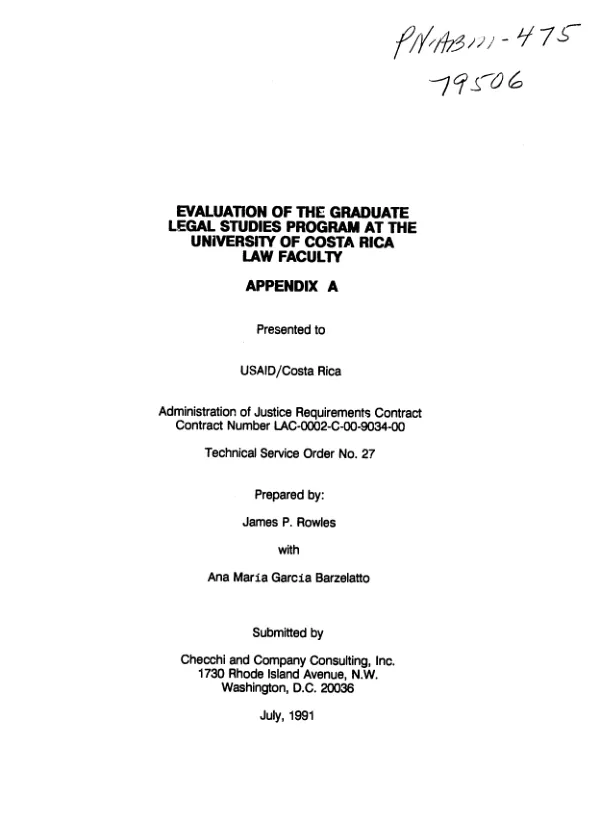
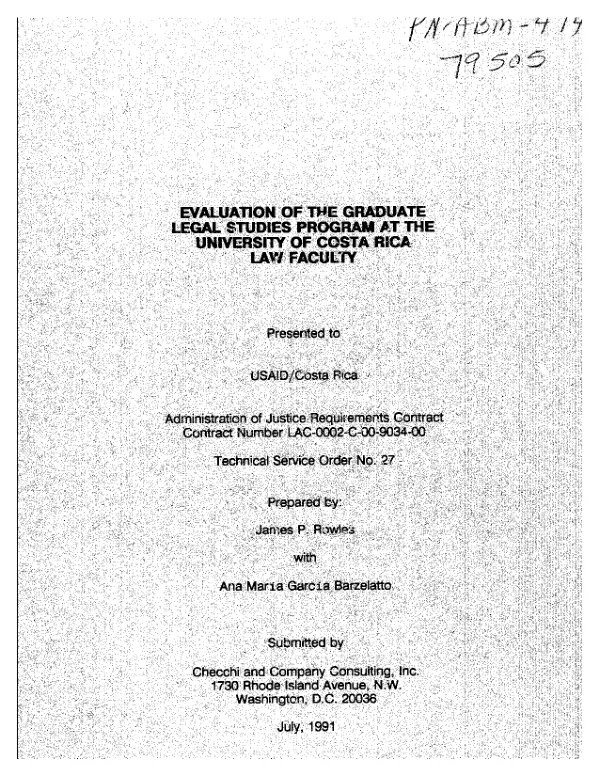
Evaluation of the graduate legal studies program at the University of Costa Rica, Law Faculty
Sign inCHECCHI AND CO. CONSULTING, INC. (CCCI)
Evaluation of the graduate legal studies program at the University of Costa Rica, Law Faculty
The University of Costa Rica's graduate legal studies program, established in 1982, has received USAID support since 1984.
Rowles, James P.|Barzelatto, Ana Maria Garcia|Garcia Barzelatto, Ana Maria · 1991
Sign in to readA free account is required to download.
Abstract
The program has achieved its goal of providing a one-year program of high-quality specialized and practical training for lawyers working in the areas of criminal law, agrarian law, and public law. With an outstanding faculty, the program is largely successful in achieving its twin objectives of teaching students how to think critically about law and legal institutions, on the one hand, and providing up-to-date training in each respective field of specialization, on the other. Total USAID support for the scholarship program amounts to $798,748. Of this sum, an estimated $750,000 has been or will be used to fund approximately 60 scholarships. Two Panamanians received scholarships, as did nineteen Costa Ricans, six Salvadorans, eleven Hondurans, five Guatemalans, and eleven Dominicans. Other scholarships are funded through bilateral programs. Of the three specializations reviewed, only public law appears to have serious deficiencies. Only three of the scholarships -- all for Costa Ricans -- were in this field. The success of the UCR graduate legal studies program and USAID's scholarship support is significant, for it contradicts the accepted wisdom among U.S. legal academics who were involved in "law and development" programs in Latin America from the mid-1950's to the mid-1970's that such programs had negative impacts, and more specifically that U.S. assistance to law faculties is a risky enterprise in terms of political exposure. Since the mid-70's there has been very little assistance to law faculties in the region -- a serious shortcoming in A.I.D.'s overall Administration of Justice and Democratic Initiatives strategy. In the countries visited during this evaluation, political sensitivity did not seem a significant problem, at least with programs such as this, which are designed to be minimally intrusive and administered with sensitivity. Specific suggestions are made for upgrading the program in the following areas: faculty; curriculum; teaching methodology; faculty salaries; student recruitment. (Author abstract modified)