 1977
1977USAID DEC
Evaluation of the management components and administration of the family planning international assistance grant
Sign inAMERICAN PUBLIC HEALTH ASSOCIATION
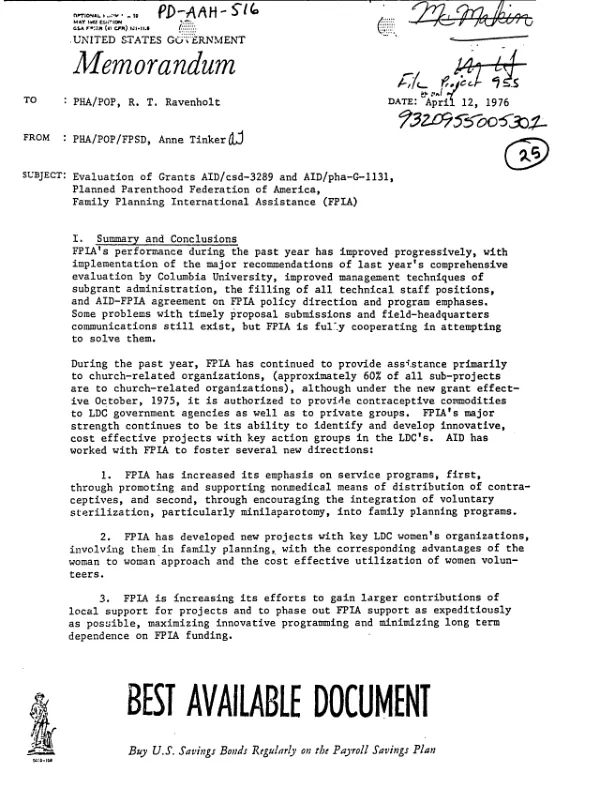
Evaluates management of a grant to Family Planning Internatonal Assistance (FPIA).
Muller, Willard C.; Epstein, Sharon · 1981
Abstract
Evaluation covers the period 1/77-5/81 and is based on document review, site visits, and interviews with A.I.D. and FPIA personnel. FPIA is meeting a critical need by providing seed money to support and expand the reach of innovative family planning (FP) service delivery programs operated by PVO"s and, to a lesser extent, the public sector in developing countries. Moreover, FPIA has a commendable system (Management By Objectives) to develop the management skills of project directors and staffs; is staffed by high caliber people; and exercises, through its headquarters, comprehensive financial management and cost-effective administration of AID-funded programs. On the other hand, regional offices are unnecessarily restricted from handling support services and have inconsistent financial management capabilities; assistance in areas other than management and programming is sometimes weak; long-range planning, including establishing interim objectives and work plans, is poor; staff have logged excessive overtime; and FPIA lacks a proper framework for evaluating programs or following up on terminated activities. It is recommended that A.I.D.: (1) continue to fund FPIA for at least 5 years; (2) streamline translation and processing services; and (3) allow FPIA to increase a program"s funding by 10% or $10,000 without prior A.I.D. approval. It is recommended that FPIA: (1) periodically review its programs and FP strategies; (2) increase the role of regional offices; (3) establish a fund for small-scale (under $10,000) projects to be operated by the regional directors under headquarter"s oversight; (4) improve long-range planning and increase the standard program funding period from 12 to 18 months; (5) collaborate more closely with USAID"s, host governments, and prospective subgrantees; (6) develop ways to systematically disseminate proven programming strategies; (7) secure an appropriate range of contraceptives for youth FP projects; and (10) modify documents to include information on other donors.
Connected topics
Classification