USAID DEC
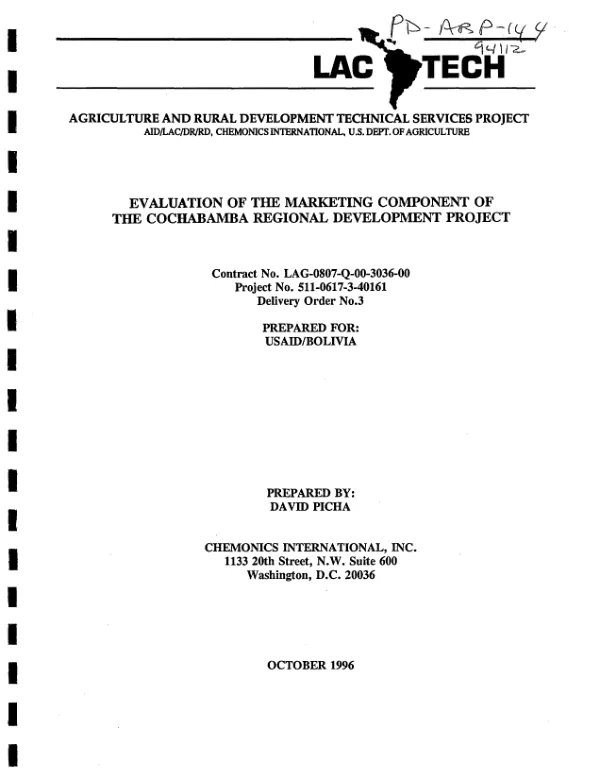
Evaluation of the marketing component of the Cochabamba regional development project
Sign inCHEMONICS INTERNATIONAL, INC.
Evaluation of the marketing component of the Cochabamba regional development project
Evaluates the nontraditional agricultural export (NTAE) marketing component of a project to develop alternative sources of income and employment for people within Bolivia's Cochabamba Department and associated areas of influence.
Picha, David · 1996
Sign in to readA free account is required to download.
Abstract
Interim evaluation covers the period 6/92-10/96. Development Alternatives Inc. (DAI) is implementing the project. Despite significant constraints, DAI has done much valuable work. Among the prioritized crops, banana has received the vast majority of emphasis, followed by pineapple. A lack of production volume of palm heart, passion fruit, and black pepper justifiably limit DAI's marketing efforts to minor involvement. The project is focusing on the right crops, with the exception of passion fruit. The real constraint to export market development is lack of consistent volume of high quality product. DAI's provision of TA to the banana and pineapple associations, improving product quality, improving post-harvest handling, offering export incentives, and facilitating market identification and penetration has been the catalyst in the development of the banana and pineapple export industry. Farm family incomes in the Chapare derived from alternative crops increased from $280 in 1993 to $520 in 1996, with farm gate value of alternative crops rising by an estimated 91%. DAI's promotion efforts have resulted in a number of new private sector investments in the Chapare. There are 14 private investors of significant scale in the Chapare with a total of $3.295 million directly committed to Chapare endeavors. While private sector sustainability in the banana export business is still several years away, DAI's activities have laid a foundation for improved agribusiness activity, export diversification and growth, and increased value-added agriculture, and have demonstrated that private sector agribusiness efforts should benefit the small farmer. Lessons learned are as follows. (1)The key ingredient for successful entry into international markets is almost always the presence of a catalyst, defined as an individual or company or a public agency, or combination of these, that (a) pioneers the process of development, (b) packages the needed know-how with domestic endowments and external financing, and (c) diffuses its experience and know-how to others. (2) NTAE businesses are high-risk ventures, and have a high failure rate because of these risks. (3) Smaller, streamlined field packingsheds, built with grower input, have proven to be more utilized and efficient than large, overcapacity, high operating cost structures. (4) Improvement in product quality and development of the export market have a positive effect on local market prices paid to the grower. (5) Credit availability is a necessary element of any alternative agriculture development program. The lack of available credit in the Chapare is a constraint to the growth of agricultural exports. (6) It is not possible to export bananas to Argentina without refrigerated container transport.