DEVELOPMENT ALTERNATIVES, INC. (DAI)
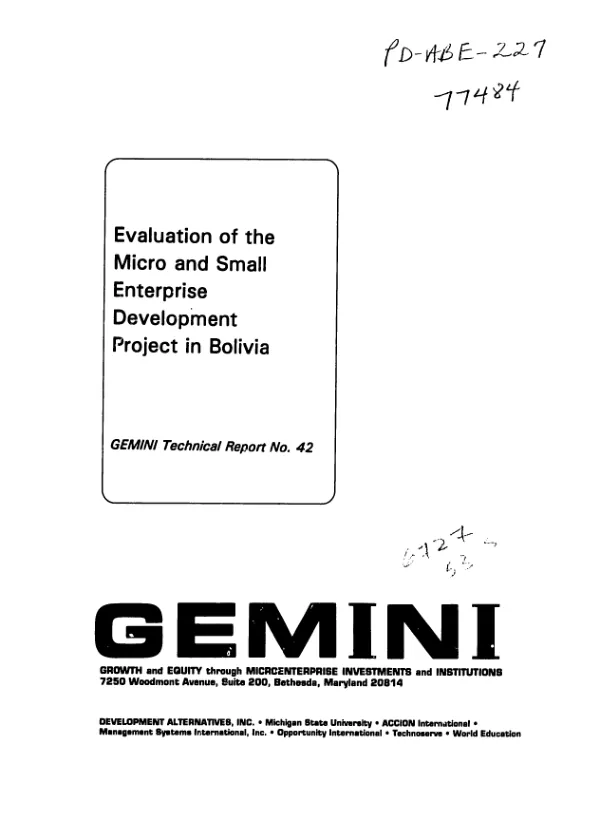
Evaluation of the micro and small enterprise development project in Bolivia
Evaluates a project to promote growth in Bolivia's small enterprise sector by strengthening the Bolivian National Federation of Credit Unions (FENACRE), the Bolivian Foundation for the Development of the Microenterprise Sector (PRODEM), and the Bolivian National Federation of Small and Micro Enterprises (FEBOPI).
Fisher, William|Poyo, Jeffrey|Beasley, Ann · 1992
Sign in to readA free account is required to download.
Abstract
Interim evaluation covers the period 1989-4/92. The FENACRE component has suffered from design problems. In particular, the institutional analysis carried out in the design stage failed to disclose serious weaknesses in FENACRE's financial health, which surfaced during an audit conducted in FY 1989. Because of the tenuous financial position of FENACRE and the credit union system in general, USAID/D has delayed disbursement of funds for credit, and external TA has been concentrated on (1) dismantling FENACRE's deposit mobilization program (an action necessitated by FENACRE's insolvency); and (2) convincing credit unions of the need for state regulation. Additionally, the project design's emphasis on creating new credit unions affiliated with Departmental Associations of Small and Micro Industrialists (ADEPI's) was flawed. Recommendations are presented for redesigning this component, and downsizing FENACRE, which should become a simple representational and lobbying institution, stripped of financial intermediation functions. PRODEM's transfer of its lending functions to BancoSol is progressing smoothly; conversion by stages has permitted the development of a positive consensus by all levels of PRODEM personnel towards the formation of a new for-profit bank. ACCION International's TA has contributed greatly to the development of PRODEM's institutional capacities; PRODEM is providing credit to increasing numbers of clients while maintaining almost negligible delinquency. BancoSol, for its part, should give priority to developing its voluntary savings mobilization program. A computerized system is being developed which PRODEM/BancoSol can use to measure the progress of microenterprises receiving credit. FEBOPI's achievements include raising government and public awareness of the problems faced by small and micro businesses, becoming the recognized spokesman for this constituency; developing a basic business training program through its eight affiliated ADEPI's; conducting research into policy constraints facing the sector and participating in policy dialogue with the government to ameliorate these constraints; helping to organize two national trade fairs to exhibit small business and micro industrial products; and providing TA to help make the ADEPI's institutionally stronger. On the negative side, FEBOPI membership represents only a small fraction of the potential constituency, and has recently declined to approximately 1,100 small businesses; also, no substantial policy reforms have taken place. FEBOPI has not yet developed services that address the two most pressing needs of the small and micro industrial sector: (1) in-shop TA, including technology assessments, preparation of business plans, and help with arranging credit; and (2) direct intervention to help member companies make contact with prospective customers and close sales. This report outlines several ways in which FEBOPI's services could be improved, and also recommends for study four new services. FEBOPI's management information system is inadequate, which is probably why its reports to USAID are often incomplete and late. A series of performance indicators are recommended to improve both management and reporting. FEBOPI's funding from USAID is due to end in December 1992, and it has prepared a self- sufficiency plan for presentation to USAID. The report sets out several options for USAID consideration.
Related documents
![Small business II project, Honduras : midterm evaluation of the ANDI/PYME [Asociacion Nacional de Industriales/Pequena y Micro Empresa] component](https://covers.devme.ai/gen/14429.webp)
![Small and micro enterprise development project no. 262-0212 [i.e. 263-0212], Egypt : midterm evaluation](https://covers.devme.ai/gen/8461.webp)
![Small business II project, Honduras : midterm evaluation of the ANDI/PYME [Asociacion Nacional de Industriales/Pequena y Micro Empresa] component](https://covers.devme.ai/gen/8459.webp)
![Small business II project, Honduras : midterm evaluation of the ASEPADE [Asesores para el Desarrollo] component](https://covers.devme.ai/gen/8460.webp)
![Small and micro enterprise development project no. 262-0212 [i.e. 263-0212], Egypt : midterm evaluation](https://covers.devme.ai/gen/106688.webp)