CHECCHI AND CO. CONSULTING, INC. (CCCI)
Evaluation of the peace fellowship program, AID project no. 263-0110
Evaluates project to establish a Peace Fellowship Program to provide U.S.
Ball, Thomas H.|Schieren, Carl · 1988
Sign in to readA free account is required to download.
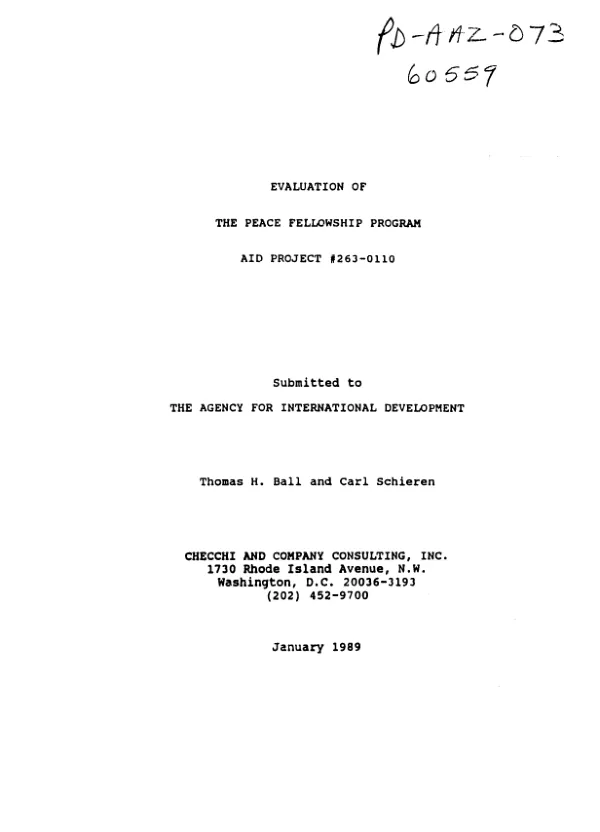
Abstract
graduate-level training in key development sectors to Egyptian students. The program is implemented by the Ministry of Higher Education (MOHE) and by the Egyptian Cultural and Educational Bureau (ECEB) in Washington, D.C. External final evaluation covers the period 1980-1/89. The program is one of the largest bilateral training programs in history and a signal achievement in U.S.-Egyptian relations. Some 2,024 students have participated in graduate studies programs, exceeding the target of 1,900; in terms of person-months of training, targets have been exceeded by 15%. The program has been available to a cross-section of English-speaking Egyptians in the academic, public, and private sectors. About half of participants have come from the universities, 38% from outside greater Cairo and Alexandria, and 19% have been women. However, in the program's second phase, to be implemented under Project 2630125 (Development Training), some changes need to be made in participant selection. Use of discipline-specific selection committees comprised only of university professors has biased the process toward applicants with good research plans. Clinical medicine has been overrepresented, accounting for 17% of total training, even though few Egyptian doctors are qualified for hands-on clinical work in the United States. It is recommended that this field be eliminated from eligibility. Although the private sector target of 12% has been met, this level needs to be raised in response to both host government and USAID/E development plans, which place increased reliance on the private sector. It is recommended that a portion of the budget be set aside for the private sector and that a new selection procedure for this group be adopted. The ECEB has functioned well in placing and monitoring participants. However, low salaries and poor working conditions have caused high staff turnover and low morale within the Peace Fellows unit. Moreover, while the unit appears capable of handling the current number of participants, the expanded follow-on project may prove overwhelming. It is recommended that special assistance be given to the ECEB in addressing these problems, as well as in providing improved orientation, field trips, and conferences for Peace Fellows. A major criticism on the Egyptian side has been that implementation has been delayed repeatedly by slow reimbursements and by low levels of obligations for new participants. Phase II of the program has an estimated life of 3 to 8 years, and an estimated funding level of $5 million to $13 million. Orderly planning cannot take place until A.I.D.'s intentions are made more clear. It is recommended that USAID/E work closely with the MOHE to ensure that the expectations of both sides are clearly stated, fully understood, and sufficiently agreed to so that implementation can take place at a reasonable pace.
![Evaluation and options for development training 2 [DT 2] : lessons learned from an ambitious training management experiment and options for promoting global performance improvement](https://covers.devme.ai/gen/81802.webp)