USAID DEC
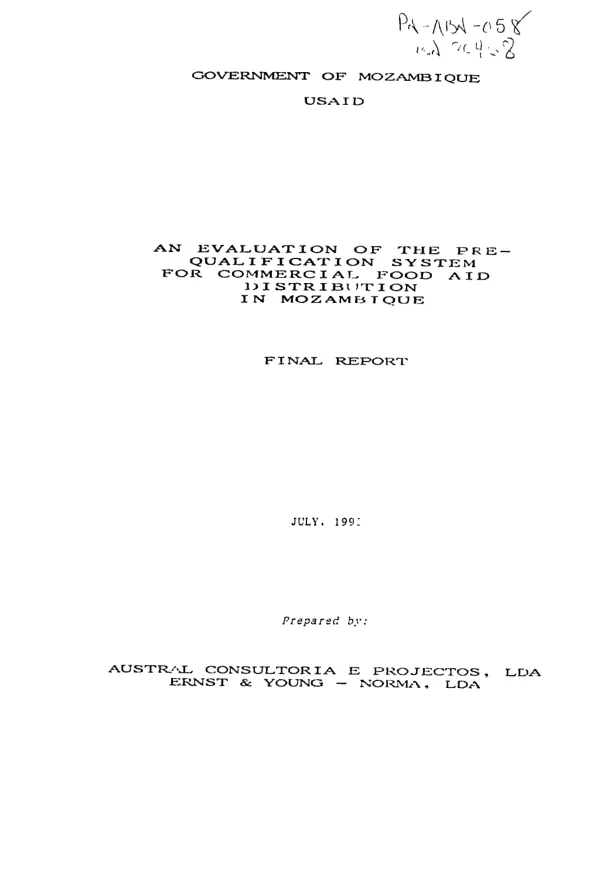
Evaluation of the pre-qualification system for commercial food aid distribution in Mozambique
Sign inAUSTRAL CONSULTORIA E PROJECTOS, LDA
Evaluation of the pre-qualification system for commercial food aid distribution in Mozambique
Mozambique began receiving commercial food aid in 1983 to assist in meeting food requirements in the major city centers and adjacent provinces.
1992
Sign in to readA free account is required to download.
Abstract
In Maputo and Beira, the aid was distributed under a system known as the Novo Sistema de Abastecimento (NSA) which controlled the eligible recipients of the food aid, quantities to move into various areas, and most importantly, prices. For distribution of food, the government created the Empresa de Abastecimento de Cidade de Maputo (EACM) and an equivalent state firm in Beira. EACM acted as a warehousing agent and wholesaler and distributed to cooperatives indicated by the Ministry of Commerce, which acted as retailers. The system, which was defined for a Maputo population of approximately 800,000, quickly began to stretch the installed capacities as people moved into urban centers. Irregular supplies of aid meant that sufficient stocks were often followed by shortages. These irregularities of supply created opportunities for speculation, particularly considering the fixed subsidized prices applied by the government. While the government tried to control this situation, the capacity of regulatory agencies was minimal. Further, with liberalization of the economy in 1987 giving opportunity for a burgeoning private sector to develop, the need for a state-owned and operated distribution and retail network became limited if not nonsensical. The move to a more liberal economy also coincided with the donor community requiring greater financial responsibility by consignees in the payment of counterpart funds. Despite increased control, by 1990 many of the state consignees owed millions of meticais to the Treasury for outstanding food aid received but not paid. Consequently, and in a move to further liberalize the distribution of commercial food aid, the government introduced in 1991 a pre-qualification system to register potential future consignees, including private sector enterprises. The purpose of this study is to review the application of the pre-qualification system since its introduction in November 1991 with reference to U.s. maize shipments. The study analyzes three key aspects; pre-qualification procedures; distribution issues; and accountability and the payment of counterpart funds. (Author abstract)
Related documents