USAID DEC
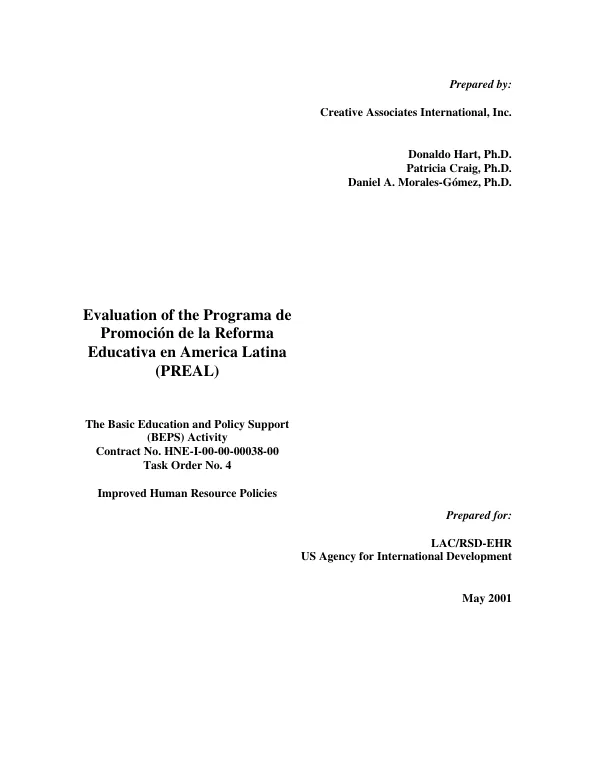
Evaluation of the Programa de Promocion de la Reforma Educativa en America Latina (PREAL)
Sign inCREATIVE ASSOCIATES INTERNATIONAL, INC. (CAII)
Evaluation of the Programa de Promocion de la Reforma Educativa en America Latina (PREAL)
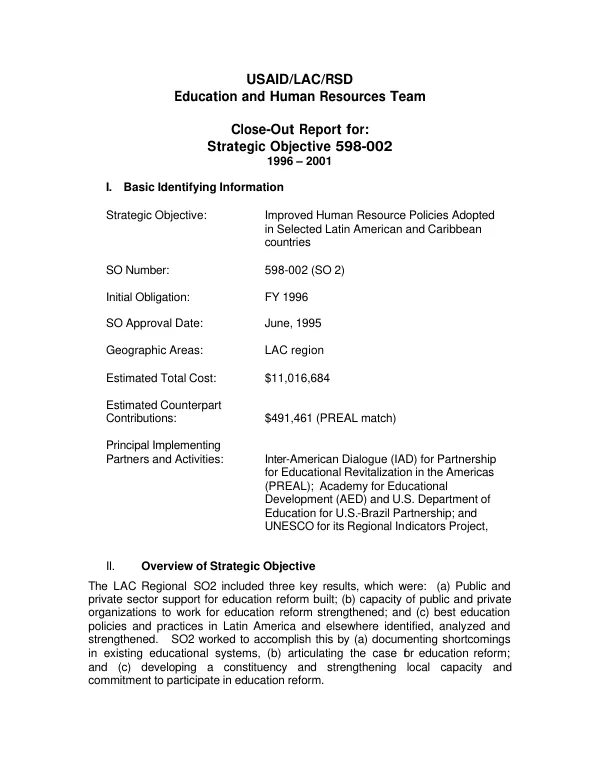
Final evaluation of a project (1996-2001) implemented by the Partnership for Educational Revitalization in the Americas (PREAL) to build public and private support for educational reform in Latin America.
Hart, Donaldo; Craig, Patricia +1 more · 2001
Sign in to readA free account is required to download.
Abstract
The evaluation is based on country studies of Chile, Honduras, Nicaragua, and Peru. Though with considerable variation, PREAL achieved in all four study countries the three intermediate results stipulated by USAID: (1) building public and private sector support for educational reform; (2) strengthening public and private sector organizations working for educational improvement; and (3) identifying and disseminating best education policies and practices. Much of PREAL"s success is attributable to the role of key individuals. The Inter-American Dialogue (IAD) has monitored inputs and outputs appropriately, but needs to monitor outcomes (e.g., policy change) more closely. The complexity of the problem area that PREAL addresses, the broad scope of its agenda and mission, and the resources available to the program raise concerns about the risk that PREAL may exceed its capacity to manage and address effectively its current program plan. Under present funding and structure, neither PREAL nor the activities it supports are financially sustainable. Although research shows no official change in educational policy directly attributable to PREAL"s activities in any of the four countries during the period of the cooperative agreement, there is evidence that PREAL has influenced the adoption, modification, and implementation of educational procedures and practices in PREAL-serviced countries. Because an important part of PREAL"s operations is managed from its regional office in Chile, the Chile country report includes general findings relevant to PREAL as a whole: (1) There is unanimous consensus that PREAL, since its origin, has made an important and relevant contribution to helping to identify education reform priorities. (2) PREAL publications and events are perceived to be highly effective and of high technical quality. (3) Where access is available, the PREAL internet site and those maintained by some of the associated centers are important and useful information tools. (4) PREAL"s approach has been appropriate to its current objectives under the existing conditions for education reform in the region. (5) There is a minority -- but important -- perception that PREAL needs to further clarify its role in relation to both its donor partners and its sponsoring and partner institutions. (6) The success of PREAL is a source of both risks and opportunities. PREAL"s success is likely to pressure the program to expand its scope and be even more responsive to external demands despite its limited resources. At the same time, PREAL"s reputation to date represents a window of opportunity to continue influencing education reform processes in the region. PREAL needs to take stock of the achievements to date and further strengthen its strategic planning process. PREAL now needs to channel its comparative advantages -- excellent networks of senior people, good research and distribution, and the ability to create a vision -- to be even more effective in translating policy reform into educational practice. Finally, PREAL, or the IAD, should not proceed alone in deliberating over future directions and relationships with USAID. There are great potential advantages in the USAID-PREAL collaboration to systematically seek advice from experts and institutions in the region as a means of enhancing their respective potential of impact. USAID has found in PREAL a solid, performing partner for its regional interests. Senior personnel from both organizations should work together to develop new strategies in order to optimize each partner"s resources and achieve the desired results. Future planning should include a discussion of the whole issue of a regional approach to policy reform, as well as to issues of national or sub-regional focus. Questions pertinent to these issues are detailed.
Related documents
Documents in this collection
 2006
2006USAID DEC
Technical assistance to the Latin America and Caribbean Bureau"s Office of Regional Sustainable Development in support of education policy reform : final report
Open record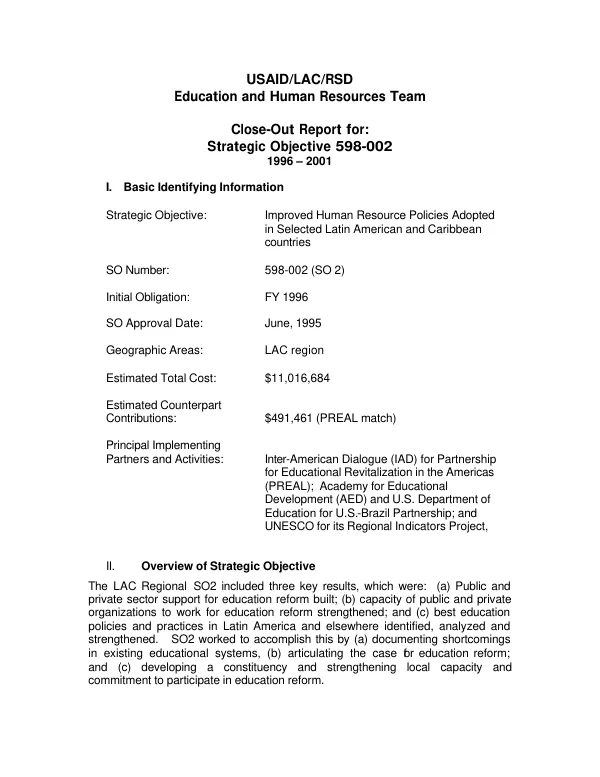
USAID DEC