USAID DEC
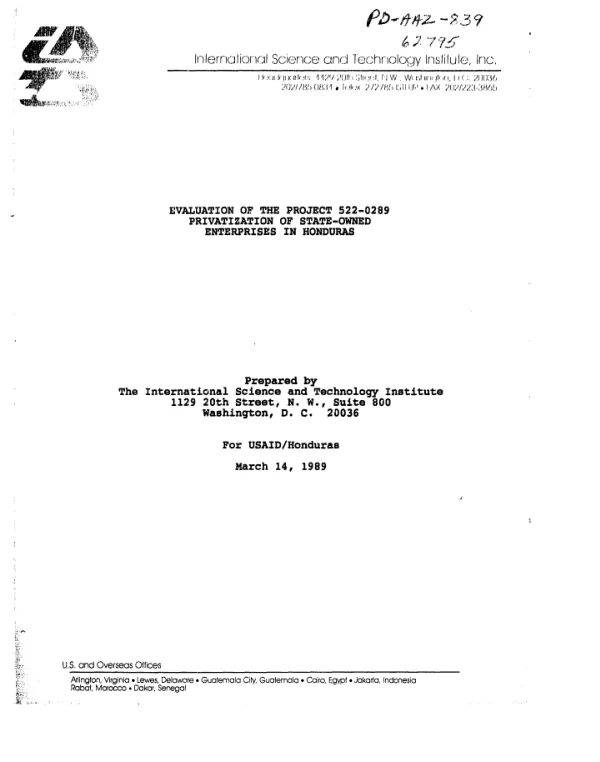
Evaluation of the project 522-0289, privatization of state-owned enterprises in Honduras
Sign inINTERNATIONAL SCIENCE AND TECHNOLOGY INSTITUTE, INC. (ISTI)
Evaluation of the project 522-0289, privatization of state-owned enterprises in Honduras
Interim evaluation of a project to provide TA in support of privatization in Honduras.
1989
Sign in to readA free account is required to download.
Abstract
Primary implementing institutions are the Corporacion Nacional de Inversiones (CONADI), the Privatization Commission, the Valuation Commission, and the Negotiation Commission. External evaluation covers the period 8/86-3/89. Although the Government of Honduras (GOH) still lacks a comprehensive privatization policy, the project has made progress towards the goal of divesting 12-15 specific parastatals. Economic benefits from the project are evident in budget gains, new jobs, additional foreign exchange, and new foreign and domestic investments resulting in more production. An even more significant indicator of success is the value of assets divested. CONADI, the largest parastatal involved, has divested 40% of its asset portfolio. On the negative side, CONADI"s poor management has been an obstacle to more efficient privatization of its assets, and COHDEFOR, another parastatal, has not assigned high priority to privatization, moving exceedingly slowly in implementing the divestiture process. Marketing and public education activities have been insufficient, and there is a general lack of public knowledge of privatization and its economic and social benefits. While there has been little organized opposition to privatization so far, the project"s plans to divest other state-owned enterprises, especially basic services, may face significant resistance from the labor sector. TA provided by the Center for Privatization has been inefficiently managed and the lack of a sustained research component, one effect of which has been an inability to determine the project"s impact on women, is a critical oversight. The Center for Privatization needs to improve significantly its relationship with and support of the TA team. In addition, the skills required of the TA director were unsuitable; substantial public sector experience and knowledge of Latin American policies and politics should have been required. On the credit side, the TA team has created an effective debt-for-assets swap mechanism, which has been used in privatizing three enterprises. In addition, the TA director has successfully maintained a low profile to avoid making the impression that the project is a USAID/H initiative instead of a GOH one.