U.S. DEPT. OF COMMERCE. BUR. OF THE CENSUS (BUCEN). INTERNATIONAL STATISTICAL PROGRAMS CENTER
Evaluation of the provincial water project in the Philippines
Evaluates project to upgrade and expand domestic water systems in five provincial Philippine cities and develop the capabilities of the Local Water Utilities Administration (LWUA).
Magnani, Robert|Tourkin, Steven|Hartz, Michael · 1984
Sign in to readA free account is required to download.
Abstract
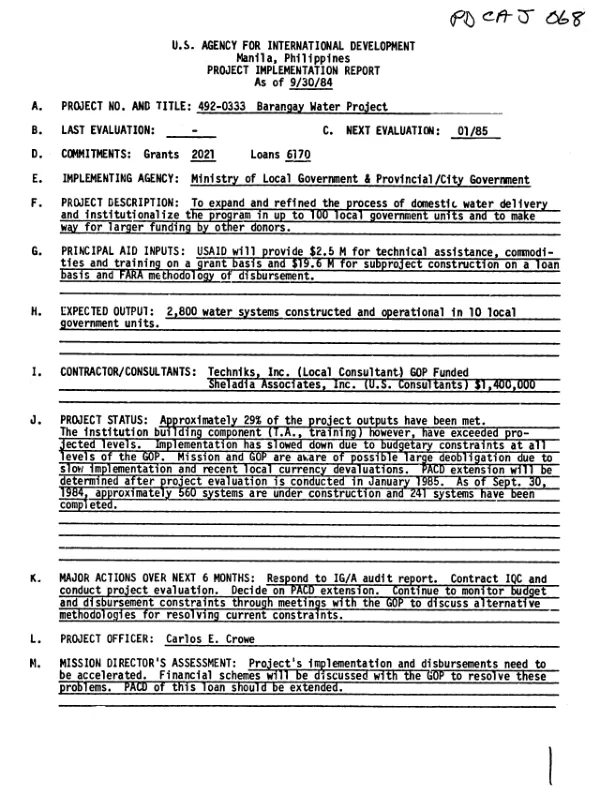
Special evaluation covers the period 1977-9/84 and is based in part on household survey data from two project cities - Cagayan de Oro and Bacolod. Despite a slowing down in implementation due to host government budgetary constraints (discussions on how to reduce these constraints are planned), the project has achieved 29% of planned outputs - 241 systems are complete, 560 are under construction (vs. a targeted 2,800), and better quality water is being delivered. The number of active connections has risen from 4,000 in each city to 19,000 in Cagayan de Oro and 13,000 in Bacolod, and the number of households using the systems as their major water source has risen from 52% to 89% in Cagayan de Oro and from 37% to 54% in Bacolod. Although users are of higher socioeconomic status than non-users - a disparity which has increased during the project - a significant number of lower-income households now have access to a reliable water supply. TA and training in excess of project targets have helped water districts and the LWUA increase service reliability and reduce water loss by 50%, but system financial viability has been achieved only in Cagayan de Oro (and only in the last year). The project has not, however, achieved its goals. There is no clear evidence of a positive health impact (as measured by incidence of infant diarrhea and by child nutritional status), although this may be partially due to a worsening economy. Analysis of water and health variables showed that improved water service will not yield a significant short-run impact unless households already enjoy a reasonable standard of living and access to sanitary facilities; in fact, income and diet were found to have the strongest health impact. Further, in both cities improper handling reduced water quality at point of use; both improved water handling and general sanitary conditions may be necessary before health impacts can be realized. The project has significantly increased gardening for home consumption, but not household businesses. A decision on whether to extend the project will be made after a 1/85 evaluation.