DEMOCRACY INTERNATIONAL, INC.
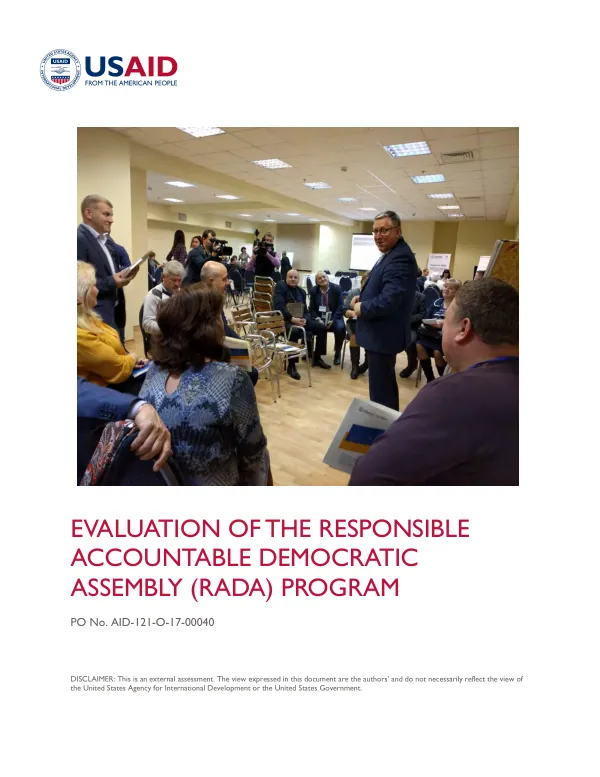
Evaluation of the Responsible Accountable Democratic Assembly (RADA) Program
The RADA Program was launched in November 2013 with the objective of advancing parliamentary reform in Ukraine.
2018 · 169 pages
Sign in to readA free account is required to download.
Abstract
The program aimed to improve public representation in the legislative process, expand the role of citizens in monitoring the work of Parliament, and strengthen the role of the legislature in providing independent oversight of the executive branch. The program was initially delayed due to the Euromaidan Revolution, elections, and a new Ukraine-EU relationship. The RADA Program has three main objectives: (1) improved public representation in the legislative process; (2) expanded role of citizens in monitoring the work of Parliament; and (3) strengthened role of the legislature in providing independent oversight of the executive branch. The program utilized a mixed-methods approach, combining qualitative and quantitative data from various sources, including document reviews, key informant interviews, focus group discussions, and online surveys. The evaluation found that the Model District initiative was the most widely known representational activity of the RADA Program. Stakeholders viewed this initiative as addressing a need of the Verkhovna Rada for greater connection between MPs and the people they represent. The Model District initiative included public comments on legislation that were incorporated into law, and it served as a vehicle for strengthening cooperation between MPs and local governments. The European Information and Research Center (EIRC) provided relevant skills and knowledge to MPs and staff, which they used in their parliamentary outreach work. Stakeholders valued the RADA Program's efforts to increase transparency and openness, particularly the transparency-promotion efforts of the NGO Register, E-Petitions, and Citizen E-Platform. The evaluation also found that the Model District initiative included many activities with an oversight component, such as visits to districts that provided MPs with information on the implementation of laws, programs, and agencies. The RADA Program established partnerships with parliamentary committees, including the Committee on Corruption Prevention and Action, and provided support for oversight of decentralization legislation. The effectiveness of the Model District initiative was illustrated by the interest in expanding the activity to include additional deputies and the participation of additional MPs in Model District activities or similar activities outside of the RADA Program. The RADA Program included parliamentary factions in the Model District initiative, but it did not include a component to work with parliamentary factions. The evaluation found that the RADA Program was effective in advancing parliamentary reform in Ukraine, particularly in improving public representation in the legislative process. The program's efforts to increase transparency and openness were also valued by stakeholders. However, the evaluation noted that the program faced challenges, including recall bias, response bias, and selection bias, which were mitigated by using multiple sources of data to triangulate on evaluation issues. The RADA Program's activities were perceived by stakeholders as most beneficial for improving public representation in the legislative process, particularly the Model District initiative. The program's efforts to increase transparency and openness were also valued by stakeholders. The evaluation found that the RADA Program was effective in advancing parliamentary reform in Ukraine, particularly in improving public representation in the legislative process.