CUTTINGTON UNIVERSITY COLLEGE
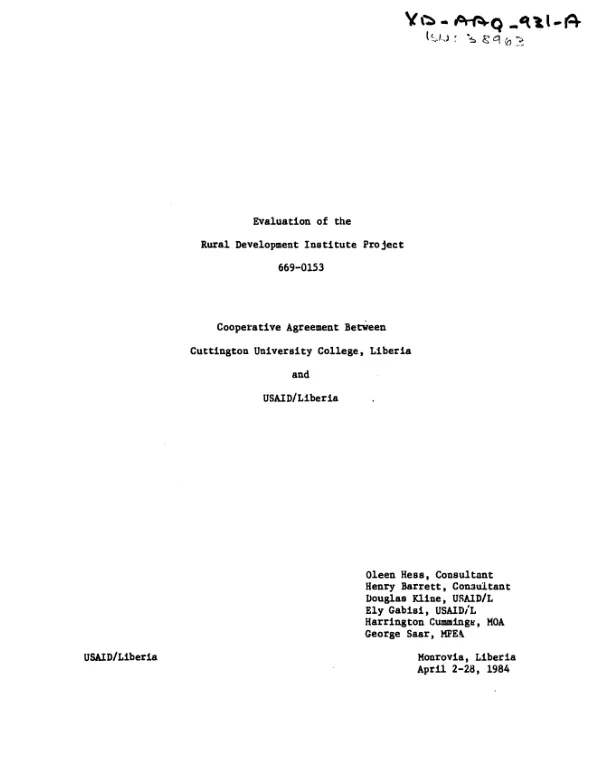
Evaluation of the Rural Development Institute project
Evaluates project to develop Liberia's capacity to train subprofessional agricultural personnel.
Hess, Oleen|Barrett, Henry · 1984
Sign in to readA free account is required to download.
Abstract
Final special evaluation covers the period 11/82-4/84 and is based on document review, site visits, and interviews with students, faculty, and officials of the Rural Development Institute (RDI). Institutional development has been adequate to justify continued support of the RDI, which has graduated 4 classes totaling nearly 300 students (85% of the first 3 graduating classes are employed in relevant agricultural work) and has made commendable progress since the 11/82 evaluation in re-orienting its curriculum toward practical skills training in plant and animal sciences; a promising Farmer Involvement Program in which second-year students work directly with farmers has been initiated. Also, a student agricultural enterprise program is being considered and progress is being made toward Liberianization of the staff. The RDI, however, is far short of the objective to reach financial self-sufficiency, and little progress has been made in administrative areas. The Institute is overstaffed, salaries and benefits are out of line with those of similar institutions, significant cost cutting measures have not been undertaken, internal administrative procedures are cumbersome, and new sources of revenue have not been sought. These administrative issues will clearly be a significant focus of the planned Phase II project. Another problem has been uncertainty about the services to be provided to RDI by Cuttington University College (CUC) and the financial remuneration involved in the sharing of services and facilities. CUC has charged RDI for services the latter neither needed nor used and has failed to pay for its use of RDI facilities. Lessons for projects establishing new educational institutions: (1) give particular attention to developing a relevant curriculum and to preparing the institution to administer its resources effectively and economically (establish administrative procedures early on and audit them regularly); (2) clearly specify in advance any sharing arrangements between institutions. Extensive recommendations - some needing attention before Phase II is initiated - are made.
Related documents
Documents in this collection
 1981
1981USAID DEC
Evaluation : Liberia rural development training at Cuttington University College Rural Development Institute
Open record 1986
1986USAID DEC