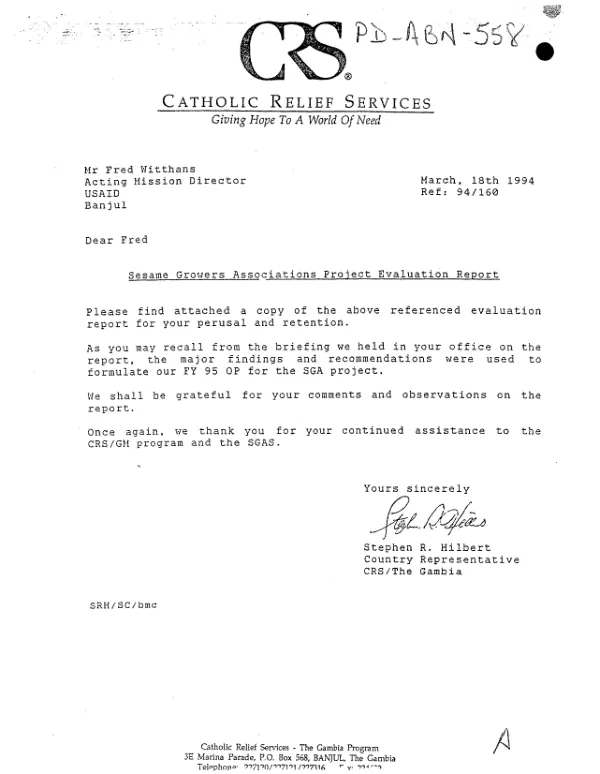
CATHOLIC RELIEF SERVICES (CRS)
Evaluation of the Sesame Growers Associations (SGAs)
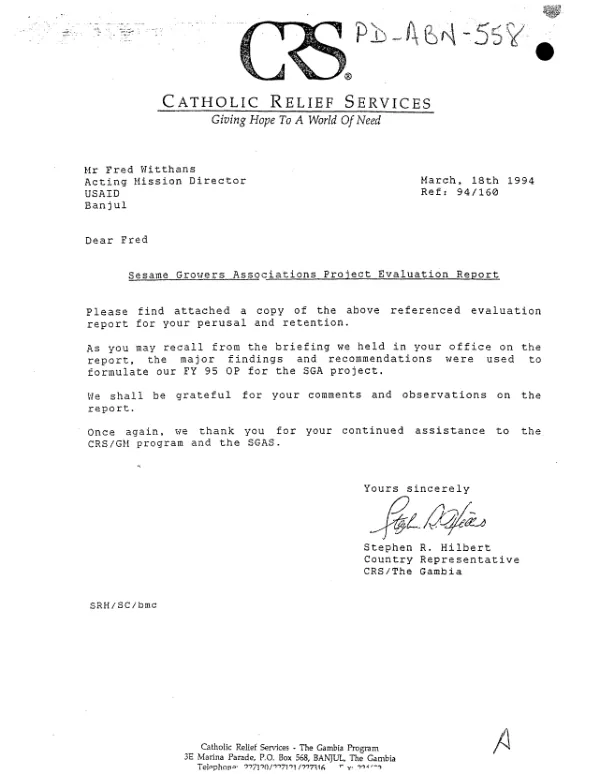
This evaluation looks at the Sesame Growers" Associations (SGAs) in The Gambia.
Diba, Abdullai; Freudenberger, Karen Schoomaker · 1994
Sign in to readA free account is required to download.
Abstract
The SGAs are rural women"s associations that are organized in a pyramidal fashion. At the base, some 56,000 women belong to about 800 village kafo associations. These associations are grouped into "clusters" of from 5 to 70 kafos. The clusters then group into 16 associations, each run by an Executive Committee (ExCo) selected by the membership. Catholic Relief Services (CRS) has been working with these associations for several years, assisting their evolution from management committees for the sesame oil expellers to more broadly based development agents that can respond to the needs of their membership. This evaluation looked generally at how the institutions have matured over the past four years since the time when they became independent associations. Specifically, it looked at how self-reliant the associations are and whether they are becoming more independent in their relations with CRS, how effective their management structures are, and how successful the associations have been in providing real benefits to their members. Among the key findings of the evaluation are the following: (1) The associations show clear signs of institutional maturing. They have their own identity and are not merely appendages of CRS (Section III and VII). (2) The associations are generally more mature and more institutionally sophisticated at the top of the pyramid (ExCo) than the bottom of the pyramid (kafo). (Sections III and IV). (3) Kafo level identification with the association is still weak. (Section IV). (4) The size of the various associations is not always well-suited to carrying out their responsibilities and strengthening their institutional identity. The size of some of the SGAs is larger than would be optimal. (Section V). (5) Sesame production is no longer the "glue" maintaining interest in the association. Sesame is declining in importance in all the associations we visited. (Section VI). (6) One of the biggest challenges facing the associations is finding projects that can provide significant benefits to members so as to retain their interest and willingness to pay dues. (Section VI). (7) Credit is, in most cases, providing more benefits to the association (through interest earnings) than it is to the individuals who receive it. The exception to this is the Gunjur Association, where investment opportunities are higher and returns to women taking loans are greater. (Section VI). (8) The associations are more self-reliant in decision-making than they are in resource mobilization. (Section VI). (9) The associations lack financial planning necessary to assure their core funding and, hence, their institutional survival. (Section VII) In general, the evaluation found that these are dynamic rural associations that can, potentially, play an important part in the development of The Gambia. CRS is strongly encouraged (Section VIII) to continue working with these fledgling organizations and to continue to search for ways that it can support the associations" development without smothering their independence or growing sense of initiative. (Author abstract)
Related documents