USAID DEC
Evaluation of the Southeast Asia Development Advisory Group (SEADAG) of the Asia Society, 1970-1972
Sign inASIA SOCIETY. SOUTHEAST ASIA DEVELOPMENT ADVISORY GROUP (SEADAG)
Evaluation of the Southeast Asia Development Advisory Group (SEADAG) of the Asia Society, 1970-1972
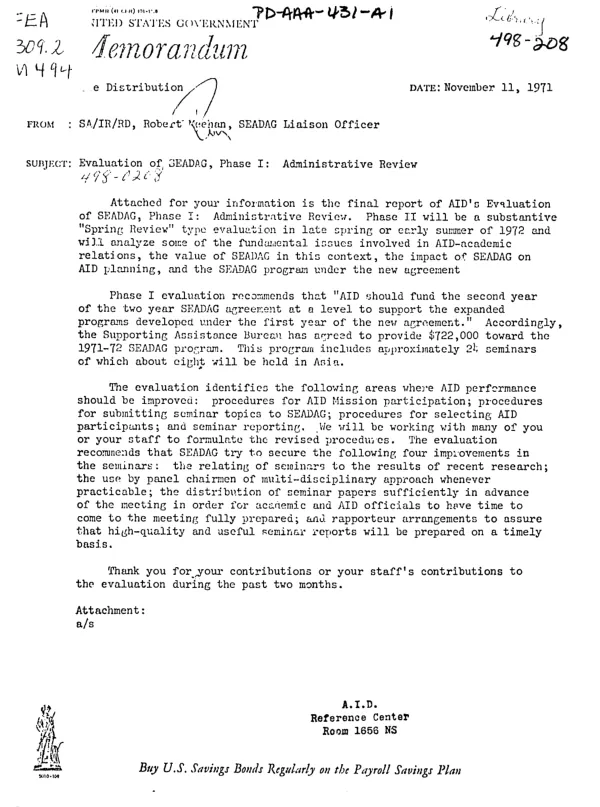
Evaluates Southeastern Asia Development Advisory Group (SEADAG) performance from 1966 to 1977 in Southeast Asia.
Rabin, Ken; Chetwynd, Eric, Jr. · 1972
Sign in to readA free account is required to download.
Abstract
Project purpose is to provide an additional channel through which official US efforts to participate in Southeast Asian econ & social development could be supported by the expertise & research of academic scholars engaged in area & functional studies. Evaluation is based on consultations with SEADAG staff & questionnaires completed by SEADAG participants. It is not presently possible to know what contributions SEADAG will have in Asian development since most programs have not yet materialized. Many papers have resulted from panel/seminars. Quality of documts, performance of panel chairmen, and organizational ability of secretariat have steadily improved. Many scholars have found SEADAG an attractive forum for inquiry and exchange between themselves, and as a means of influencing the activities and policies of AID. Although funding adequately supports present activities, it is felt that more emphasis could be placed on selected problem areas. Frustrations in the early years of SEADAG resulted due to: 1) the constraints of Congress; 2) limited funds; 3) disenchantment of scholars with US policy, 4) lack of SEADAG"s directn; and 5) frustrations in finding a congenial divergence between their expectations and the role of SEADAG. Presently rigid time dimensions limit the performance of panel chairmen; quality of manuscripts need improvement; and the lack of communication between SEADAG and other organizatns has resulted in duplicatn of research. Recommendations are to: 1) continue activities where there is increased dialogue with Asian policy makers; 2) upgrade publicatns using outside ad hoc committees to edit & appraise manuscripts; 3) increase time in recruiting panel chairmen allowing them to visit other panel/seminar meetings & chairmen; 4) provide chairmen funds for travel to DC for briefing as to their relationship to AID & to Asia to recruit panels; 5) upgrade quality of research papers by having less meetings; 6) improve communicatn with other Asian organiztns & between AID & SEADAG.