PARTNERS OF THE AMERICAS
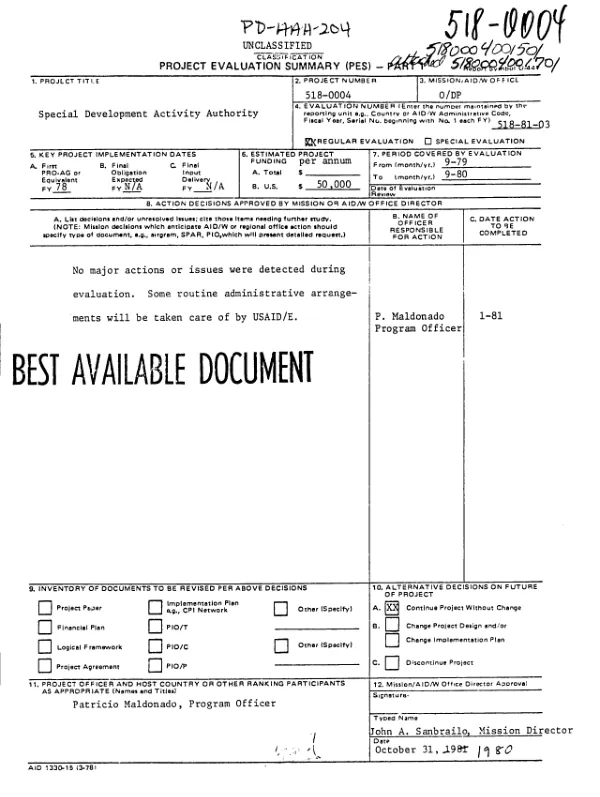
EVALUATION OF THE SPECIAL DEVELOPMENT ACTIVITY AUTHORITY FOR FY 1979
Evaluates project to separately fund small constructive activities.
STRONG, NED D. · 1980
Sign in to readA free account is required to download.
Abstract
This special evaluation, prepared by Fundacion Campaneros de las Americas and attached to a PES (PD-AAH-204-A1), covers the period 9/1/79-9/30/80 and is based on onsite interviews with subproject directors. The 18 subprojects, which range from rabbit production to forestry to schools and small businesses, are evaluated according to the following criteria: rate of completion; type of administration; type of group involved; location; level of community investment; group involvement in funds management and project planning; experience in previous projects; level and time span of income generation; appropriateness of technology; and return on investment. Of these 11 factors, six were prime determinants of success and five were relatively unimportant. Community involvement was found to be critically important; the greater its extent, the higher the chance of subproject success. Type of administration was the most influential factor: only one of the six activities which were less than 20% complete had a community-based administrative mode, but all eight of the activities which were over 80% complete had a community-based administration. The most successful community administrators were found to be Peace Corps volunteers, while absentee administrators were least successful. Also, cooperatives and associations, especially those with a purpose parallel to the activity, had a higher completion rate. Other guarantors of success are community cash and in-kind investment; community involvement in funds management and project planning; and short-term income generation activities. The evaluators recommend that the program be continued and expanded. Stricter limits should be imposed on the spending of project funds. Finally, an onsite screening interview with potential administrators should be conducted to promote the implementation methods most likely to succeed.