TROPICAL RESEARCH AND DEVELOPMENT, INC.
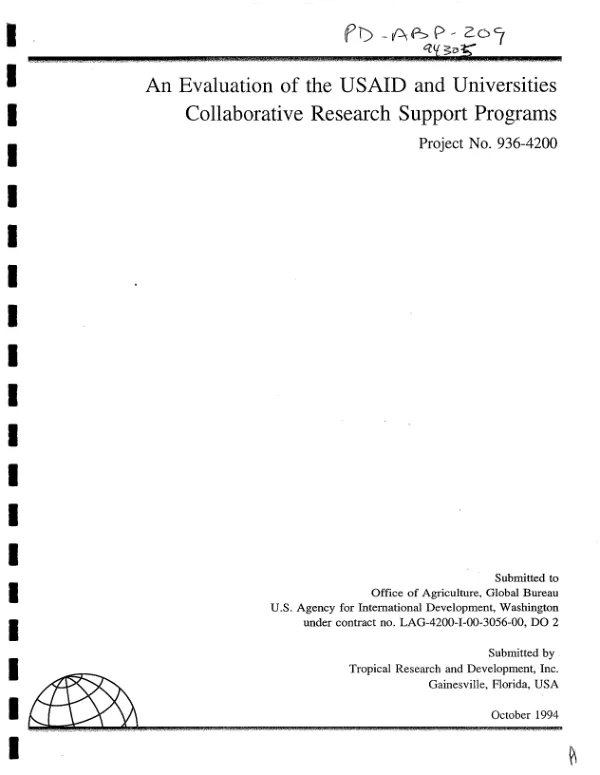
Evaluation of the USAID and universities collaborative research support programs
Evaluates seven Collaborative Research Support Programs (CRSPs) between USAID and U.S.
Swindale, Leslie D.|Barrett, Izadore · 1994
Sign in to readA free account is required to download.
Abstract
universities and other research organizations, implemented between 1979 and 1985. Individual CRSPS focused on: sorghum/millet, beans/cowpeas, small ruminants, soil management, pond dynamics/aquaculture, peanuts, and fishery stock assessments. The CRSPs have largely achieved their objectives. They have educated over 1,700 scientists from the United States, host countries, and developing countries; improved crop cultivars for use by farmers, and contributed substantially to the body of knowledge concerning tropical soils, agriculture, and fisheries; and developed new techniques that should substantially improve fishery stock assessments, pond aquaculture, pest and disease control, and plant and animal breeding. Some CRSPs developed new computer software to improve interventions in commodity production. The pond dynamics and aquaculture, bean/cowpea, and small ruminant CRSPs to date have had the most impact per dollar spent in the developing countries. The sorghum/millet, bean/cowpea, and peanut CRSPs have had the most impact per dollar spent within the United States. Unmet goals include the development of new food products with significant commercial value, development of a multivalent vaccine for small ruminants and of soil management technology transfer methods, and analyses of a pond dynamics and aquaculture experiment. The CRSPs have helped create a legacy of scientific personnel, most of whom have returned to their home institutions to continue contributing to agricultural research management and national development policy. Unfortunately, direct beneficiaries of the CRSPs were predominantly male; the goal of gender equity was not articulated from the outset and accountability for it was not demanded by USAID project managers. The CRSPS also clearly increased the institutional capacities of participating U.S. universities. All participating universities matched their required cost-sharing contributions, and several contributed at higher percentage levels. Conversely, the CRSPs have not been very successful in fostering governmental recurrent cost support for local research institutions. Mission buy-ins to test the validity of new or improved technologies have proven satisfactory and USAID should seriously consider assisting a follow-up, utilization phase of activities beyond the CRSPs. In terms of management, an effective CRSP program requires a minimum structure consisting of a management entity, a Board of Directors, a technical committee, and a well-functioning external evaluation panel (recommendations for improving the effectiveness of these entities are included in the report). However, expatriate country coordinators, most of whom have been withdrawn, are now seldom necessary or even advisable. The major problem cited by the CRSP management entities was USAID's inability to honor its financial commitments to the CRSPs in full and on time; there was a gap of approximately $20 million between the original grant appropriations and actual grant authorizations. As a result, some research activities were cut short, some operations closed in host countries, some scientists and staff were discharged prematurely, and entire CRSP components had to be eliminated. Most of the management entities also voiced strong concerns about the persistent and inexplicable delays in receiving annual funding authorizations from USAID. However, most of these problems are solvable. Future CRSPs, particularly if they maintain their global focus, must be truly multidisciplinary, integrating biological, physical, and social scientists. They should also work to ensure a critical mass of scientists in a range of disciplines, trained at the best universities, and possessing the minimum equipment, facilities, and communications links needed to be effective. Greater effort in supporting regional networks is also urged. The following lessons were learned. (1) Title XII legislation has led to a perception of "entitlement" among participating institutions that is not always a positive force in research design and implementation. (2) The CRSPs have faced unresolved dichotomies between research and development activities, and in allocating resources between global and local research needs. (3) When new scientific knowledge is sought through CRSP projects, it should have a strategic character, applicable within a reasonable time to ameliorating specified development constraints. (4) Universities have placed great emphasis on CRSP training outputs. USAID needs to recognize that universities are more likely to produce high-quality training outputs than to generate technological outputs. (5) The dissemination of CRSP research outputs requires persons with the contextual skills and perspectives that the CRSP scientists may lack.
Related documents
Documents in this collection
 1995
1995USAID DEC
MARYUT II : mid-term evaluation of the integrated agricultural development project-MARYUT complex in the western desert of Egypt
Open record 1995
1995USAID DEC