ALEXANDER, MACLENNAN, TRUNDELL AND CO.
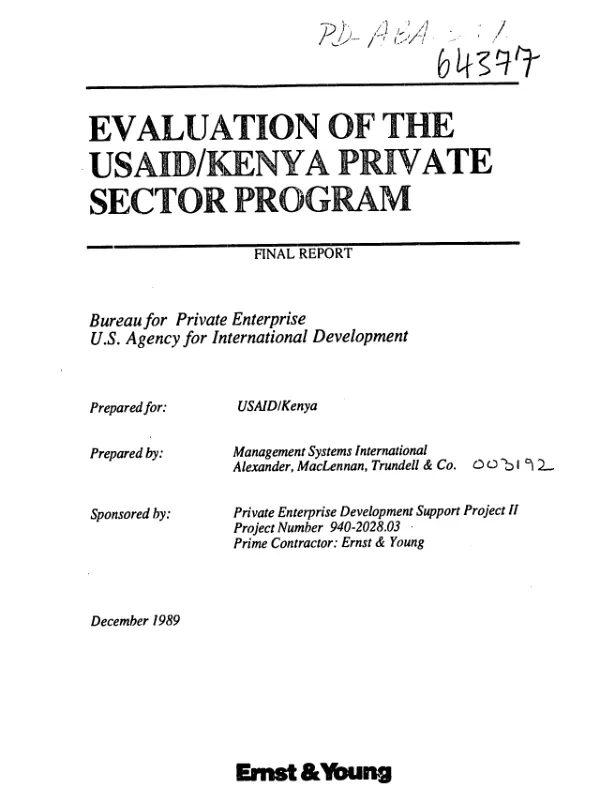
Evaluation of the USAID/Kenya private sector program : final report
Evaluates the private sector development program of USAID/Kenya.
Cooley, Lawrence S.|Brown, Barbara · 1989
Sign in to readA free account is required to download.
Abstract
The program consists of five projects -- Rural Private Enterprise (6150220), Private Enterprise Development (-0238), Informal Sector and Loan Guarantee Grant (-0227), and two Commodity Import Programs (-0213 and-0240). External evaluation covers the period through 4/89. The program, which accounts for 43% of total Mission outlays for active projects, has undertaken a number of excellent and complementary pilot activities, some of them with substantial future potential. These include, inter alia, support for policy studies, assistance in deregulating financial markets, and in stock market reform, small and microenterprise lending, agribusiness lending, recycling Mission funds to targeted businesses, and collaborative work with Government officials in finding practical ways to relax well-known constraints. There are also several areas with significant potential that are not included in the program's current portfolio; these include infrastructure supportive of trade and investment promotion, business training for medium-scale entrepreneurs, and assistance in strategic planning to the Rural Enterprise Program and to local PVO's. On the other hand, several program activities appear to have reached the limits of their effectiveness in the current policy environment. For example, finance and capital market development activities will be successful and cost-effective in the long term only if the government continues to liberalize capital markets. Current capital mobilization efforts are seriously constrained by regulation of interest rates and equity markets as well as by the Government of Kenya's limited absorptive capacity for TA in this area. High loan default rates and administrative costs have constrained the establishment of sustainable loan programs. Moreover, the program has had difficulty in undertaking investment programs that target Kenyans due to a lack of sound business proposals from indigenous entrepreneurs. Another program constraint has been the weakness of Kenyan policy analysis capabilities. Many agencies lack the capability to absorb policy information or to commission useful policy studies, and there are not many experienced policy analysts in universities or consulting firms. The projects have made significant institutional impacts on several intermediary institutions. The potential for continued growth is promising in NGO's, business associations, and capital market institutions, but not very promising for the country's largest commercial banks, given current constraints in financial markets. The strategy of imposing conditions precedent to disbursement of project resources is of limited usefulness, even for the commodity import programs. Since there is already widespread recognition in Kenya of the value of a market-driven economy, USAID/K's most important role is likely to be in policy reform management, rather than in prescribing further necessary changes. In addition to examining program level impacts, the evaluation includes detailed reports on 20 individual activities conducted under the five private enterprise projects.
Related documents