USAID DEC
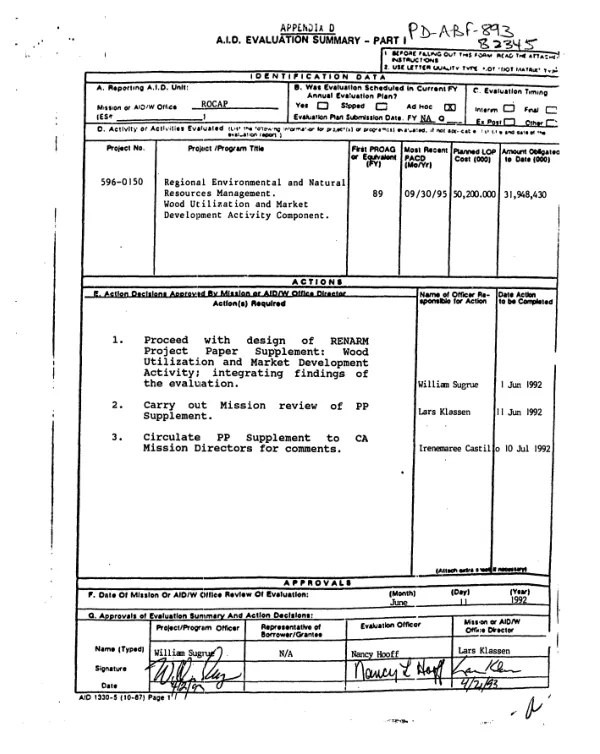
Evaluation of the wood utilization and market development activity : sustainable agriculture and forestry component of the regional environmental and natural resources management project
Sign inSTEWART HOLMES & ASSOCIATES
Evaluation of the wood utilization and market development activity : sustainable agriculture and forestry component of the regional environmental and natural resources management project
Evaluates a component of the RENARM (Regional Environmental and Natural Resources Management) project in Central America.
Holmes, Stewart · 1992
Sign in to readA free account is required to download.
Abstract
The component, implemented by the Interamerican Management Consulting Corporation (IMCC) under contract with ROCAP, aimed at developing higher value wood products from underutilized tree species in Guatemala, while simultaneously providing for sustainable forest management. Ad hoc evaluation covered the period 1989-6/92. For an overview of the success and importance of this component, see PD-ABF-893. Detailed accomplishments have been as follows. (1) While IMCC"s strategy of initiating a large number of small activities (none of which are implemented in depth) has met with criticism, it has also been the primary vehicle through which ROCAP"s presence has been felt throughout Guatemala. (2) IMCC"s manager, Mr. Molinos, has been a great asset. He has played a key role in the formulation of a vastly improved forestry law and has acted as both a facilitator and a mediator between agencies involved in the forestry sector, although people in some U.S. agencies consider his work to be too political. (3) IMCC is credited with introducing the country to borate treatment of wood products, a process which, if widely adopted, could be a key factor in changing people"s attitudes towards wood as a renewable long-lasting resource. However, to truly affect the forests of the region, the work with borate treatment will require a great deal of effort on the part of ROCAP. (4) IMCC has stimulated the interest of many artisans and larger industrialists in increasing the use of lumber from non- or underutilized species such as alder and oak. In addition, some work has been done with ramon, Santa Maria, and other species from the Peten. This program would benefit enormously if the United States and other industrialized countries banned the importation of key species like Spanish cedar and mahogany except in finished products. (5) IMCC has developed the basis for managing existing forest stands for multiple and sustained use through the creation of markets for alternative (to firewood) forest products. Demonstration construction activities using both sawed lumber and the stems of small trees were helpful in this regard. Important offshoots of the program could be the development of alternative uses for thinnings (pruning residues) from Central American fuelwood plantations. Once again, however, sustainability of this effort will involve a long-term effort (decades). (6) IMCC also provided TA in air and kiln drying to producers of construction lumber and showed sawmillers the benefits of proper care and filing of saws; these efforts should improve both the quality and quantity of lumber produced.
Related documents
Documents in this collection
 1992
1992USAID DEC
Evaluation of the wood utilization and market development activity : sustainable agriculture and forestry component of the regional environmental and natural resources management project
Open record 1993
1993USAID DEC
![PACA [proyecto ambiental para Centro America] final evaluation workshop -- proceedings synthesis : Belize, Costa Rica, Guatemala, Honduras -- cooperative agreement no. 596-0150-A-00-0586-00, 1990-1995](https://covers.devme.ai/gen/6851.webp)
![Mid-term evaluation of the shared control of natural resources [SCOR] sub-project, Sri Lanka](https://covers.devme.ai/gen/7067.webp)