USAID. BUR. FOR GLOBAL PROGRAMS, FIELD SUPPORT, AND RESEARCH. OFC. OF WOMEN IN DEVELOPMENT
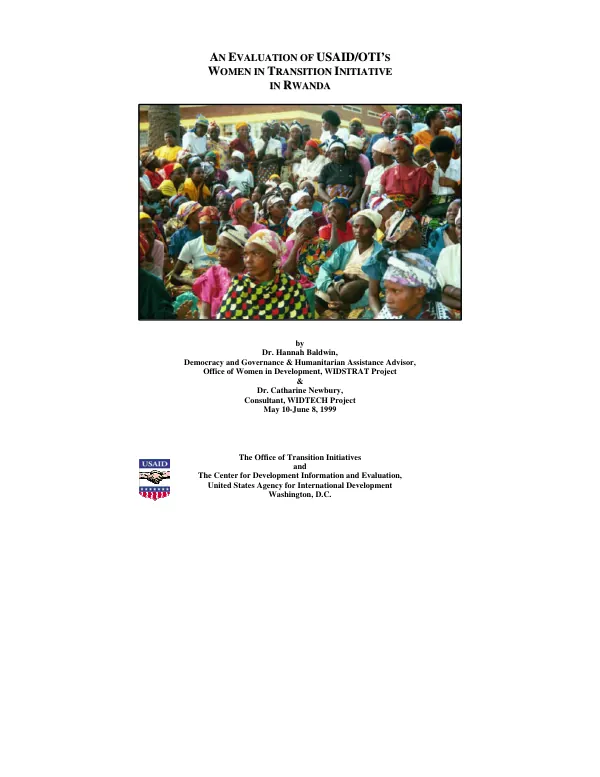
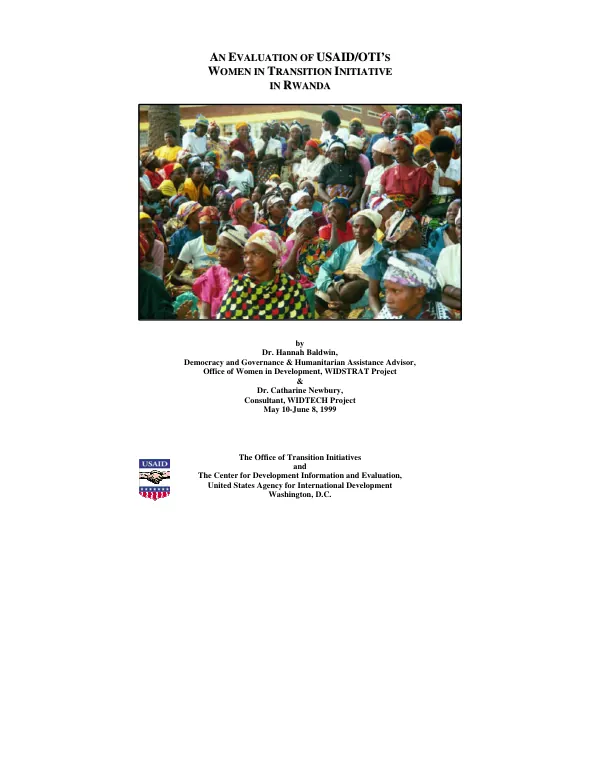
Evaluation of USAID/OTI's women in transition initiative in Rwanda
Evaluates the Women in Transition (WIT) Initiative, designed to help women and other disadvantaged groups in Rwanda rebuild their lives.
Baldwin, Hannah|Newbury, Catherine
Sign in to readA free account is required to download.
Abstract
Interim evaluation covers the period 9/95-5/99. WIT has made an important contribution to rebuilding women's lives in Rwanda. It has worked in 86 communes, funded 1,460 projects, reached 29,254 association members, and assisted over 160,000 people -- all with modest funding and low administrative costs. WIT has been effective in meeting the needs of poor and vulnerable -- working directly with rural women's associations in small livestock, agricultural, and microenterprise activities. It has reduced community tensions by helping women and the vulnerable build homes, feed themselves, and restart their lives economically. It has helped build unity and create space for reconciliation by bringing women together in associations. The real problem exists between widows and the wives of men in prison who have been accused of genocide. Even between these there are examples of reconciliation, e.g., in Commune Runyinya, where, in a religious context, women are coming together in forgiveness. WIT has contributed to women's political participation. The Ministry of Gender created local women's committees to assist in WIT implementation and monitoring; WIT projects gave women opportunities to participate in local decisionmaking as part of these committees. Leaders of WIT-funded and other associations were recently elected to local councils (4 of whose 10 elected members must be women), and there is a anecdotal evidence that women are being elected to seats not reserved specifically for women. The development of Women's Communal Funds (WCF) to support economic growth is another important aspect of WIT's contribution to the empowerment of Rwandan women. The unusual partnership between the Ministry and USAID has been an important factor in the success of WIT. Ministry support at the commune level has ensured WIT's effectiveness, while the USAID umbrella has enabled WIT to act independently and provided the resources needed to carry the program to the most isolated rural areas. WIT's small size has helped keep it flexible. WIT systems, which require women leaders to step out of traditional roles, travel long distances, and interact with officials, has taught women and their communities that women are capable leaders. WIT's management structures have ensured the effective use of resources and created an organization that can adapt to evolving situations. WIT is positioned to contribute to the achievement of USAID's local government and household food security strategic objectives, but must be tied more closely with USAID training and program planning. WIT is most effective as a program that draws on both the Ministry and USAID, but remains essentially independent of both. This unique position has empowered WIT and enabled it to do more than it could have done in another form. Lessons learned are as follows: (1) Activities that promote and increase women's economic empowerment can lead to political participation. (2) Economic activities, particularly in groups and associations, help reduce tension and create unity in post-conflict settings. (3) Activities that require women to assume non-traditional roles in one area help them to acquire the necessary confidence and self-esteem to take on non-traditional roles in other areas. (4) When women are seen as leaders and as capable of helping others address their problems, they can be elected to positions that would otherwise be filled by men. (5) Targeting rural women's associations in post-conflict settings is a viable addition to, but does not replace, targeting national, urban-based NGOs, which continue to play a role in directly addressing government on their level, e.g., on women's legal rights. (6) Local control of resources through mechanisms like the woman-managed WCF can be models for future transition and development programming. (7) Many current mechanisms of the Office of Transition Initiatives (OTI) provide USAID a model for working in transition environments. (8) USAID needs to develop more flexible implementation mechanisms. One-time inputs may be insufficient to launch particularly vulnerable and impoverished groups into a development phase. Groups with problems should be studied, and follow-up assistance provided under certain conditions.