USAID. MISSION TO EGYPT
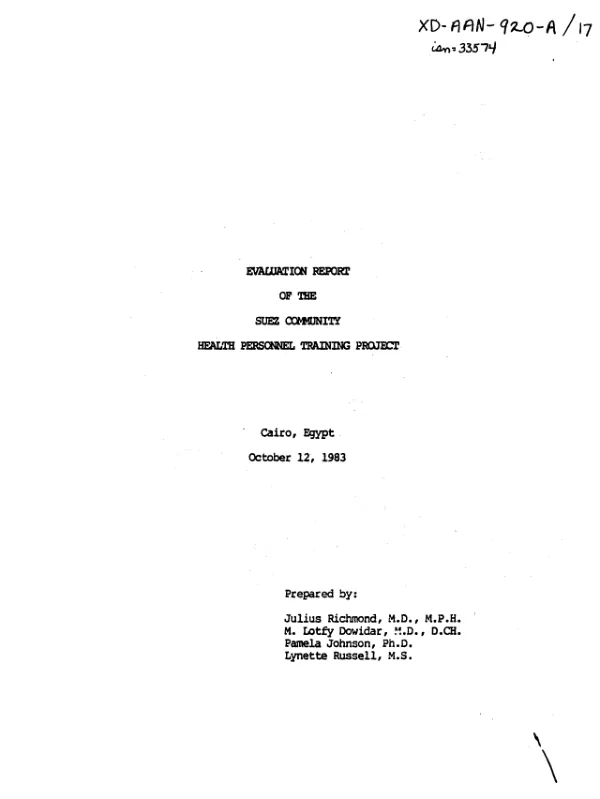
Evaluation report of the Suez community health personnel training project
Evaluates project to establish an integrated medical education and health services program in 5 governorates bordering Egypt"s Suez Canal.
Richmond, Julius; Dowidar, M. L. · 1983
Sign in to readA free account is required to download.
Abstract
Special evaluation covers the period 6/81-10/83 and is based on document review, site visits, and interviews with USAID/E and Government of Egypt Ministry of Health personnel, Suez Canal University (SCU) faculty/students, and others. The SCU Faculty of Medicine (FOM) has made remarkable progress toward project objectives. The first 3 years of a unique curriculum emphasizing primary health care has been developed; the second, mainly clinical, 3 years have been designed. A highly motivated staff of 152 faculty (mostly junior members) and 26 physicians in residence have been recruited with offers of subsidized housing, a chance to take part in Egypt"s first group practice, research opportunities, and short and long-term training (25 have thus far been trained, including 5 in long-term U.S. programs). Three undergraduate classes, 195 students, have begun medical training; 45 physicians have entered the Master"s general practice (GP) program (the first 14 graduated in 3/83). FOM building renovations were completed in 1981. Microbiology, pathology, and anatomy labs have been set up and a hematology lab will open soon. A medical library, maintenance department, and audiovisual center are being developed; however, the former has been unable to recruit a librarian and the latter two, although equipped and staffed, have inadequate management. The project is already having a positive impact on community health services. FOM students work 2 days a week at 12 urban/rural MOH health centers (4 of which have been renovated with teaching annexes) in Ismailia, Port Said, and the Suez Governorates. Also, 2 GP Master"s graduates have become health center directors and others are awaiting assignment. However, the FOM has been hampered by inefficient internal management (e.g., overly centralized authority; lack of commitment by some faculty; and inadequate support staff). Key recommendations are to strengthen FOM administrative and financial capabilities and the clinical program and to expand community health services delivery.