USAID DEC
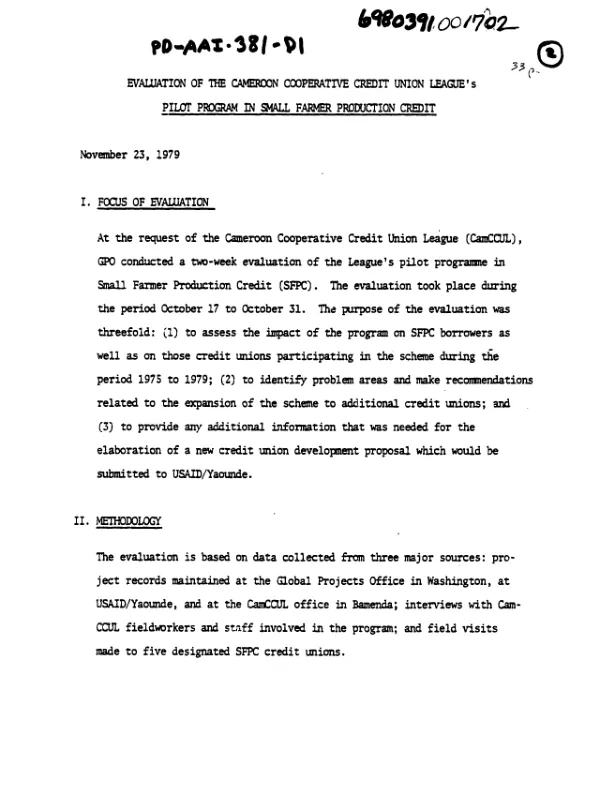
Evaluation report : USAID financed National Savings and Cooperative League of Sierra Leone
Sign inPANNELL KERR FORSTER
Evaluation report : USAID financed National Savings and Cooperative League of Sierra Leone
Evaluates project to help Sierra Leone"s National Savings and Cooperative League (NASCCLOS) strengthen and expand its network of affiliated societies (CC"s).
1984
Sign in to readA free account is required to download.
Abstract
Special mid-term evaluation covers the period 1981-9/84 and is based in part on visits to CC"s. While the project"s impact on credit and savings societies in Sierra Leone has been considerable, neither NASCCLOS nor CC development has met expectations because figures for active CC"s and total membership used in project design were inflated. NASCCLOS met only 14.6% of its expenditures during 1983 vs. a targeted 50% (although expenditure has been well controlled and consistently below budget), due to low income from affiliation fees and stationery sales and, more significantly, to problems in collecting dues from CC"s (the rate of dues payable is on target at 2% of savings, but rate of collections was only 17% in 1983, vs. a planned 80%), and to delays (arising from a dispute between NASCCLOS" parent organizations, now resolved) in implementing a planned risk management program. NASCCLOS has provided regular (and well-attended) training for CC officials (training 96 vs. a planned 52), and NASCCLOS administrative, accounting, bookkeeping, and personnel procedures have been raised to an efficient level and are fully documented in a 1984 manual. However, no long-term development planning (and only limited short-term planning) has been carried out. Promotion of urban worker-group societies has been unsuccessful, in contrast to NASCCLOS" consolidation in the provinces. While CC"s have improved considerably, without the bookkeeping services provided (to 161 CC"s vs. a planned 180) by NASCCLOS field workers and regional service centers, most would be unable to keep proper records or provide statements (although 340 secretaries and 2,535 members have been trained, exceeding targets of 180 and 1,960). CC-level loan extension has been satisfactory, but loan repayment rates are low; furthermore, few CC"s pay dividends on savings to attract new members. Standardized stationery is used by 92% of CC"s surveyed, and standard administrative procedures are being disseminated, but NASCCLOS has failed to introduce a central finance scheme, even though this and risk management are the services most desired by CC"s. NASCCLOS is now in good condition to develop further; it is vital that technical and financial assistance be continued.