USAID. BUR. FOR DEVELOPMENT SUPPORT. OFC. OF RURAL DEVELOPMENT AND DEVELOPMENT ADMINISTRATION
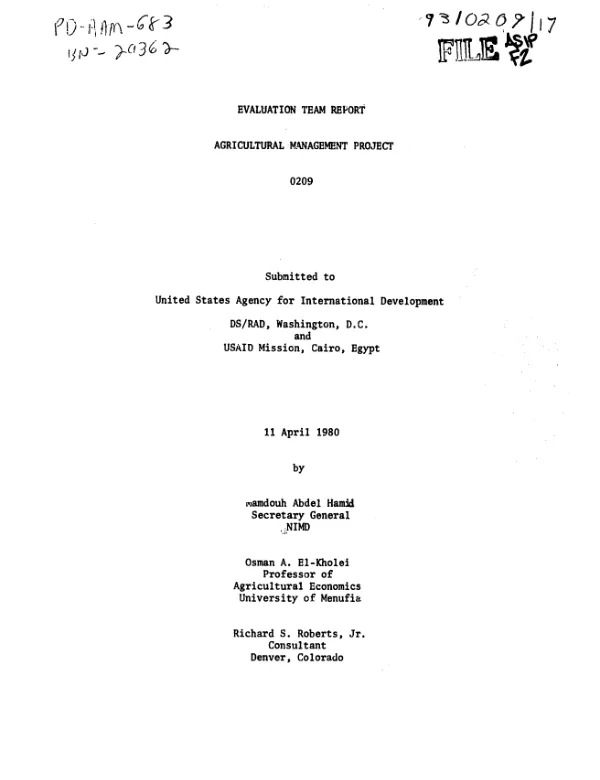
Evaluation team report : agricultural management project
Evaluates project to implement in Egypt the Agricultural Sector Implementation Project (ASIP) approach for training agricultural managers and to develop an Egyptian supplement to the International ASIP Reference Book.
Hamid, Mamdouh A.|El-Kholei, Osman A.|Roberts, Richard S., Jr. · 1980
Sign in to readA free account is required to download.
Abstract
Special evaluation covers the period 10/77-3/80 and is based in part on interviews with trainees. The project did not achieve its planned results by its original termination date of 10/79, and was extended to 7/31/80; since the extension the project has picked up momentum. About 200 midlevel and a few senior managers have been trained; the basic course is being taught by Egyptians in Arabic for the first time; and an enthusiastic, though small, Egyptian staff is gaining experience. However, the task of institutionalizing the ASIP method is far from complete. Preparation of an Egyptian reference book on agriculture management is also far behind schedule, but a small collection of "Successful Practices" is being assembled. Several factors have contributed to the project's deficiencies. The project design was "Egyptianized" too late and at too low a level. Contractor capabilities did not meet the scope of the project, especially the research aspects (needs assessment, identification of successful practices, and development of the reference book); at least one team member should have had a clear grasp of ASIP methods and a good working knowledge of Arabic. Inadequate supervision by AID/W caused confusion in communications. Because the project has not been institutionalized in terms of the Ministry of Agriculture budget, it has been handicapped in both planning and staffing by uncertainty about available funds. There has been no systematic assessment of the project's impact on actual management practice. Activities complementing training, e.g., follow-up and consulting work, need strengthening. Most importantly, the project has made little effort to involve top-level and lower-level (e.g., cooperative managers) personnel. Recommendations are made for a follow-on project which would incorporate a comprehensive results-oriented management development program.