IRI RESEARCH INSTITUTE, INC.
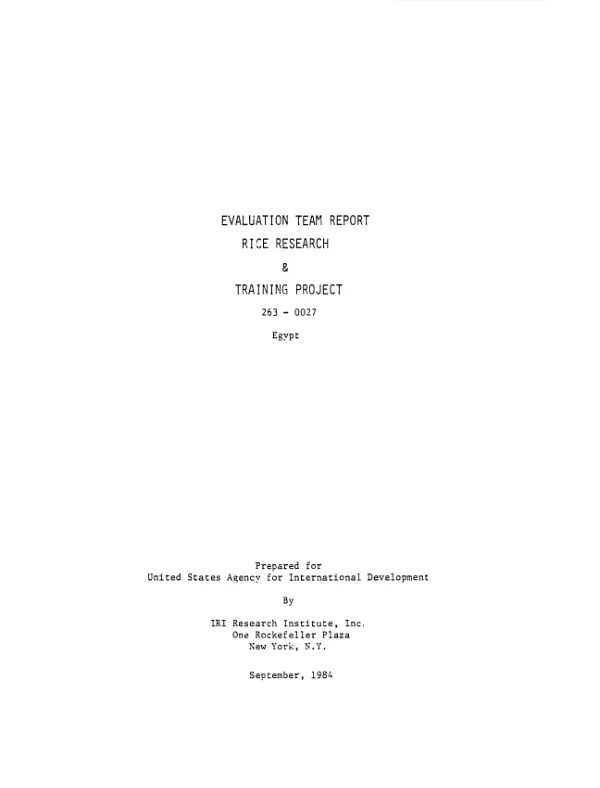
Evaluation team report : rice research and training project
Evaluates project to increase Egypt's research, extension, and training capabilities in rice production, seed processing, and storage.
1984
Sign in to readA free account is required to download.
Abstract
Special evaluation covers the period 9/79-10/84 and is based on document review, site visits, and discussions with project staff. Progress has been exceptional in most activities. Extension has directly helped over 90,000 farmers cultivating 46,500 feddans to produce yields 59% above the national average. Financially, extension has been most helpful to farmers cultivating less than 1 feddan (1.03 acres). Registered seed, free from red rice, has been produced for 3 years, and enough of the new certified Giza 173 seed was produced to plant 50% of rice acreage in 1984. In addition, the project has trained 63 extensionists, 25 national rice advisors, 2 Ph.D. candidates, and 5 persons in postdoctoral and 5 in nondegree studies. However, the entire effort is in danger of unraveling because the National Rice Institute has not been endowed with permanent status (without which there can be no means to assure ongoing research and training capabilities). The project has also been affected by low rice prices and a lack of timely inputs, as well as, initially, by such typical implementation problems as finding trainees with adequate English skills, providing transportation for extension, clearing commodities through imports, and securing full-time counterparts. In addition to the crucial issue of institutionalization, several other problems must be addressed: rice mechanization has not progressed well and should focus on one machine (i.e., a thresher) or be eliminated; and additional TA is needed in blast screening and in the installation of laboratory and processing equipment. Also recommended are greater coordination with other projects and acceleration or expansion of selected project activities. Lessons learned: (1) provision of permanent status to a new institution (along with its own staff and budget) is essential; (2) typical implementation problems should be realistically addressed in project design; (3) quantifiable targets can help maintain momentum; and (4) high returns are possible from production-oriented research and active extension, especially in a favorable environment. (Near East Abstract, modified)