USAID DEC
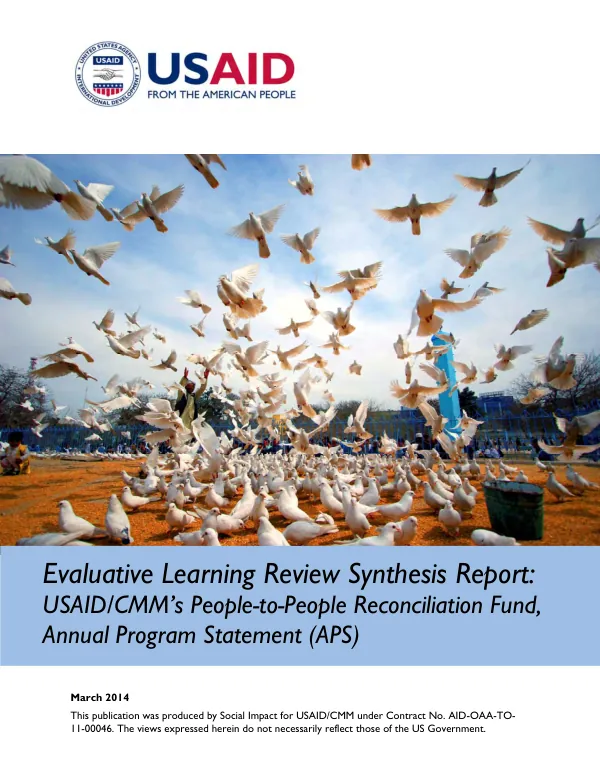
Evaluative learning review synthesis report : USAID/CMM"s People-to-People Reconciliation Fund, annual program statement (APS)
Sign inSOCIAL IMPACT, INC.
Evaluative learning review synthesis report : USAID/CMM"s People-to-People Reconciliation Fund, annual program statement (APS)
Since 2004, the United States Agency for International Development"s (USAID) Office of Conflict Management and Mitigation (CMM) in Washington has held an annual Reconciliation Program Fund small-grants competition through an "Annual Program Statement" (APS).
Allen, Susan; Kjaer, Mathias · 2014
Sign in to readA free account is required to download.
Abstract
The APS is funded through a Congressional appropriation mandate that grants utilize a people-to-people (P2P) reconciliation approach to guide their work. According to CMM"s "People-to-People Peacebuilding: A Program Guide," the underlying Theory of Change (ToC) is that in "communities where elites or other societal forces have damaged or severed the relationships connecting individuals and groups of differing ethnic, political, religious, or other identities…[building or rebuilding] strong, positive relationships will mitigate against the forces of dehumanization, stereotyping, and distancing that facilitate violence." Thus, by creating a safe space where representatives from conflicting groups can interact, prejudices and perceived differences of "others" can be confronted, challenged, and hopefully ultimately replaced by "mutual understanding, trust, empathy, and resilient social ties." In the fall of 2011, CMM awarded Social Impact (SI) a contract to conduct a two-year evaluative learning review of targeted awards and activities under the CMM People-to-People Reconciliation APS through a pilot application of this developmental evaluation methodology. The objectives of this review were not only to learn about the reconciliation APS projects themselves, but also to build CMM"s technical leadership in evaluation of complex programs. The evaluation team"s work was divided into three phases, which were not necessarily implemented in succession, but rather with learning and action reflection steps integrated throughout: Phase I, knowledge management and study of the reconciliation APS; Phase II, field evaluation of selected APS programs; Phase III, reflective learning. This final report is a synthesis of not only the five key products, but also the findings from the process of undertaking an evaluation inspired by a developmental evaluation framework and the lessons this can provide not only CMM for future APS work, but peacebuilding programming and evaluation more broadly. After the introduction key findings from each of the five products are presented as a summary. The report is then divided into individual chapters with the full desk review, meta-evaluation and analysis, and three field evaluation reports presented individually. The final two chapters review and synthesize findings on: (1) the APS" efforts to support conflict mitigation and reconciliation activities around the world, consider these in light of the guidance on P2P reconciliation, and offer scenarios of potential future developments in the APS; and (2) evaluation of the APS to date, and offer values, principles, and scenarios for potential development of evaluation within CMM, USAID, or similar complex settings. In addition, the evaluation team"s reflections on the team"s process of adapting a developmental approach to evaluating this type of programming are offered in the final chapter. (Excerpt, modified)