USAID DEC
Executive summary of the proposed collaborative research support program on beans and cowpeas
Sign inUSAID. BUR. FOR DEVELOPMENT SUPPORT. OFC. OF AGRICULTURE
Executive summary of the proposed collaborative research support program on beans and cowpeas
Collaborative Research Support Program (CRSP) to develop an ongoing, multidisciplinary, multi-institutional research and training effort to increase bean and cowpea production and use in East and West Africa, Latin America, and the Caribbean, where these crops are a staple.
1980
Sign in to readA free account is required to download.
Abstract
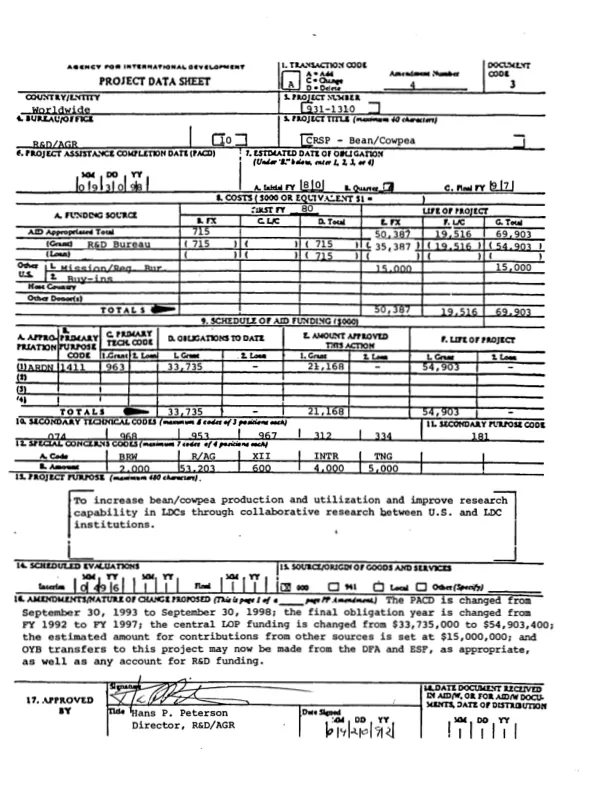
Ten Title XII universities will work with personnel from 12 LDC"s, focusing on the needs and resources of subsistence farmers. The participating universities will be Cornell, Michigan State, Mississippi State, Washington State, Colorado State, and the Universities of California, Riverside, California, Davis, Georgia, Nebraska, Puerto Rico, and Wisconsin. An administrative entity will be established to coordinate project activities. Of critical importance will be the development of collaborative research relationships among participating universities, LDC institutions, and associated international centers and programs. Research will address a wide range of barriers to increased bean and cowpea production and use. Specifically, it will seek to increase and/or improve: (1) generalized disease and pest resistance and/or biological control in field and in storage; (2) yield and yield stability; (3) plant adaptation and resistance to environmental stress; (4) nitrogen fixation; (5) seed softness; (6) understanding of traditional farming systems; (7) legume protein digestibility; (8) processing and preserving methods; (9) data on the comparative economic values of new technology versus traditional practices; and (10) indigenous professional capacities. LDC personnel will be trained through formal academic programs at participating U.S. universities; graduate assistantships; short courses, seminars, workshops, and special programs; and direct collaboration with U.S. scientists. Up to 30 person-days of TA per year will be provided free to any country (LDC institution or USAID) requesting it; additional TA can be arranged. TA will focus on designing, implementing, and evaluating projects in bean/cowpea development and adapting CRSP research to local situations. Amendment of 10/11/84 increases funding and extends project 3 years to FY88. However, the four "troubled" country projects (Brazil/Hagedorn, Cameroon, Honduras, and Kenya) identified in the 5/84 project evaluation will not be extended automatically, but will be carefully reviewed first. (PD-AAP-886) Amendment of 3/27/89 increases funding and extends project 3 more years through 9/92. To reverse a severe reduction in number of trainees, graduate training will be reemphasized. The project will also give priority to the economic benefits of project research (as in the case of Senegal), and establish additional collaborative linkages with other international projects, programs, and institutions. (PD-AAZ-399) Amendment of 4/26/92 extends the PACD 5 years through 9/98 and increases funding. The project will continue to support a variety of research projects in participating countries addressing biological, production, socioeconomic, processing, and consumption-related constraints to bean and cowpea cultivation and utilization. (PD-ABD-946)