USAID. MISSION TO NICARAGUA
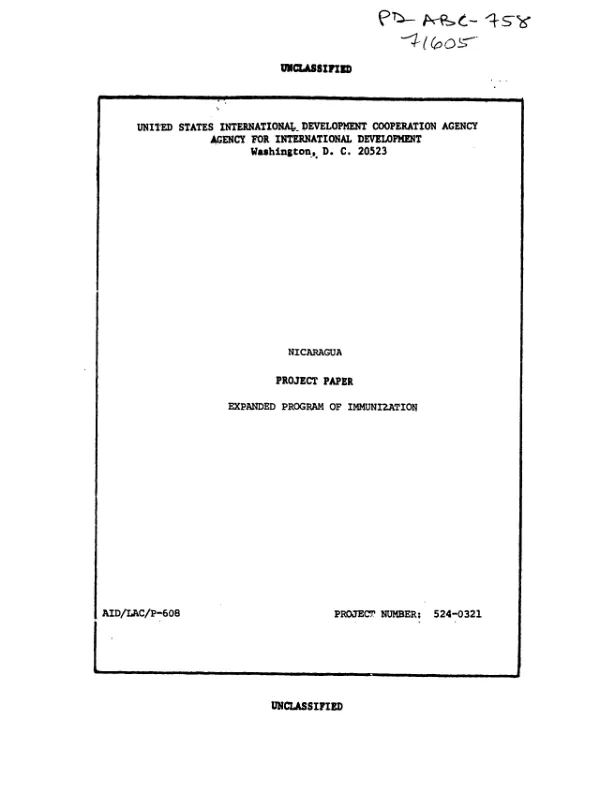
Expanded program of immunization
Project to increase vaccination coverage of children under 1 in all of Nicaragua"s municipalities and strengthen the national epidemiological research and surveillance system.
1991
Sign in to readA free account is required to download.
Abstract
The Pan American Health Organization (PAHO) will help the National Directorate for Communicable Diseases (DNET) implement the project"s three components -- immunization, epidemiological surveillance, and coordination with private medical practitioners. Initially, DNET will develop an immunization action plan, targeting of measles and neonatal tetanus (two diseases for which immunization coverage has been particularly low) and will undertake an inventory of the cold chain, replacing or servicing equipment as necessary and training regional and local health personnel in its maintenance. Once an operational strategy and effectively maintained cold chain are in place, DNET will administer the following vaccines throughout Nicaragua: (1) anti-polio vaccine to 80% of children under 4; (2) DPT to 80% of children under 5; (3) BCG to 80% of children under 1 and to 90% of children under 5: (4) tetanus toxoid to 80% of women of childbearing age (especially to pregnant women) and to 30% of children aged 10-14; and (5) measles vaccine to 80% of children under 1 and to 90% to children under 5. In accessible area, the vaccination campaigns will be conducted through fixed clinics, while in areas that have not been covered recently because of the civil war, or which have recently been settled by nonvaccinated war immigrants, DNET will use a strategy combining house-to-house programs, small targeted campaigns, and/or mobile brigades. Some 20,000 community workers will be trained in immunization strategies and techniques. Epidemiological bulletins, as well as 2,000 EPI manuals, will be distributed at the national, regional, and local levels. The project will work to expand epidemiological surveillance, particularly of polio, which the Ministry of Health believes may be underreported. DNET will send suspected disease samples to Guatemala for testing. However, clinical and computer equipment will be purchased to improve in-country diagnostic and analytic capabilities. Epidemiological surveillance of immuno-preventable diseases will be conducted throughout 1991, data will be distributed to the field regularly, and DNET will conduct training in epidemiology standards so that local personnel will be better able to diagnose preventable childhood diseases. Finally, DNET will solicit support and participation from the private medical profession by (1) training personal physicians, paramedics, and hospital staff in diagnosis of immuno-preventable diseases, (2) conducting national conferences on epidemiology for pediatricians, and (3) financing a professional exchange with Guatemala for two pediatricians. Rotary International and UNICEF will also contribute to the project.
Related documents