USAID DEC
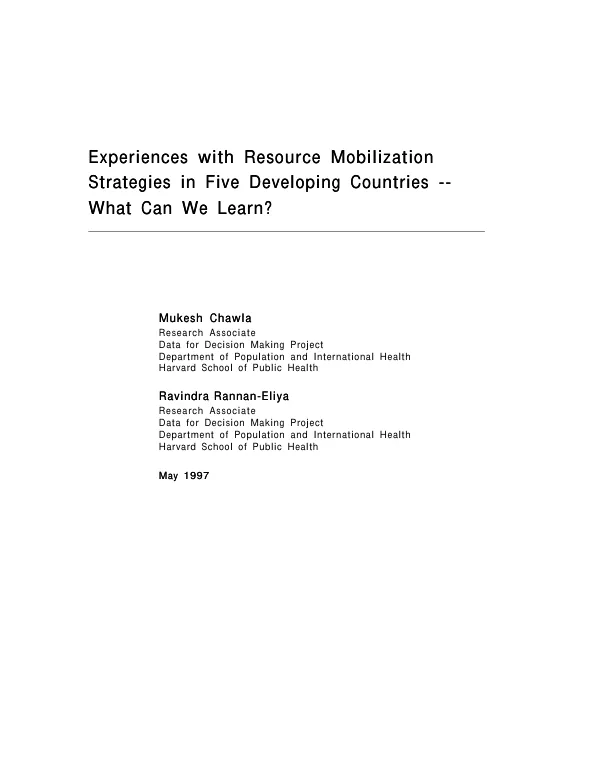
Experiences with resource mobilization strategies in five developing countries : what can we learn?
Sign inHARVARD UNIVERSITY. SCHOOL OF PUBLIC HEALTH. DEPT. OF POPULATION AND INTERNATIONAL HEALTH
Experiences with resource mobilization strategies in five developing countries : what can we learn?
This report explores the results of case studies conducted on the experiences of five developing countries (Ivory Coast, Senegal, Zimbabwe, Bolivia, and Sri Lanka) with strategies to mobilize resources for health finance.
Chawla, Mukesh; Rannan-Eliya, Ravindra · 1997
Sign in to readA free account is required to download.
Abstract
The study focused on the impact of different resource mobilization strategies (increased allocations from general government revenue, specially targeted public revenue-raising efforts, contributions from private donors and foreign assistance, social health insurance, private health insurance, and user fees) on government and non-governmental sources of finance, on resources for public goods and primary health care services, and on efficiency, equity, and quality of care. The overall conclusion is that although governments often make decisions about individual resource mobilization methods, they rarely think in terms of a strategy of health financing that considers the overall mix of methods, their interaction with one another, and their linkages with other components of the health care system. Not surprisingly, therefore, the success of individual methods, even if they have been well thought out and implemented, has been limited in terms of contributions to resources, efficiency, equity, and quality of care. At the same time, most governments tend to ignore the role of household spending at private providers in financing health services. On the more positive side, the studies show that where it has been possible, private and community initiatives have succeeded in raising funding in the health sector. Includes bibliography.
Related documents