USAID DEC
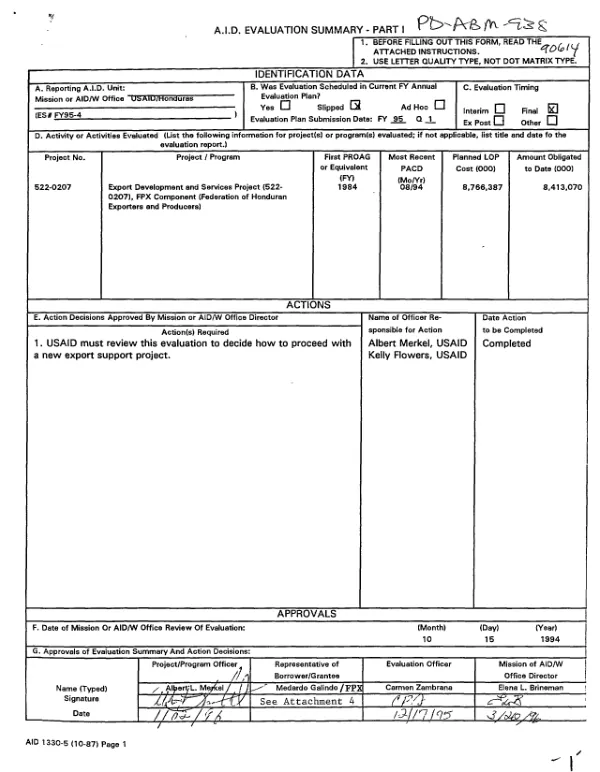
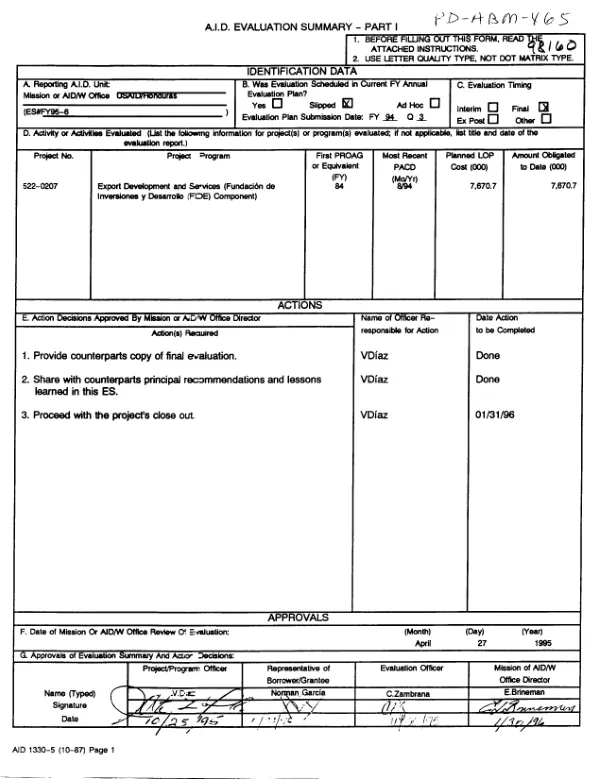
Export Development and Services (Fundacion de Inversiones y Desarrollo (FIDE) component)
Sign inUSAID. MISSION TO HONDURAS
Export Development and Services (Fundacion de Inversiones y Desarrollo (FIDE) component)
Summarizes final evaluation (PD-ABM-175) of the Foundation for Research and Business Development (FIDE) component of a project to promote nontraditional exports (NTEs) in Honduras.
1996
Sign in to readA free account is required to download.
Abstract
The FIDE component focused on promoting manufactured NTEs. The evaluation covered the period 1988-94. The evaluation found that FIDE had: (1) become a highly competent professional institution with influence in Honduras well beyond its small size; (2) achieved financial self-sufficiency, enabling it to maintain its core program of investment promotion and export development without further external assistance; and (3) met its economic targets, creating 35,000 new jobs, promoting export sales of nearly $400 million, accounting for 99 new investments valued at nearly $200 million, and, most importantly, contributing 6-8% of Honduras" GDP. FIDE is also helping to reduce poverty in Honduras. Nearly half of the new hires in FIDE-supported export apparel operations were previously unemployed and quality of life indicators improved significantly in areas where these operations were located; 70% of the new hires were women (against a national average of 30% for female participation) and wages were 80% higher than previous earnings and 20-30% over the minimum wage. Finally, FIDE contributed to a positive economic policy environment for exports, most notably by helping to secure passage of the Investment Code in 1993, which provides for a one-stop window for investors; also, a comprehensive policy document prepared for the Reina administration was extremely well-received. Lessons learned include the following. (1) Successful investment promotion requires a favorable economic and social climate. Government of Honduras reform efforts, begun in earnest in 1990, contributed importantly to FIDE"s success in promoting investments. (2) While successful investment promotion need neither be terribly expensive nor require a large supporting institution, it does require a good product. In the case of Honduras, there is a readily available, low-cost, reasonably productive labor force in a country with good proximity to the U.S. market. (3) Export assembly is much more efficient than transforming local raw materials as a way of increasing employment and foreign exchange in the near term. (4) Focusing on one or two subsectors is the most efficient way of pursuing investment promotion and precludes the dissipation of scarce resources. (5) General trade and investment promotion institutions cannot be sustained solely through user fees, and must seek other funding sources. (Author abstract)
Related documents
Documents in this collection
 1994
1994USAID DEC
Final evaluation : Fundacion de Inversiones y Desarrollo de Exportaciones (FIDE) (export development and investment promotion activities)
Open record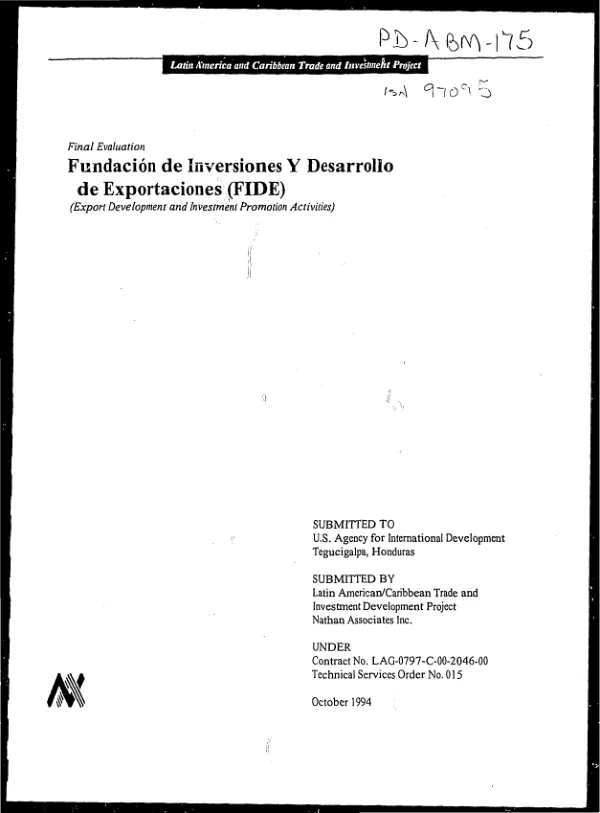 1994
1994USAID DEC