USAID DEC
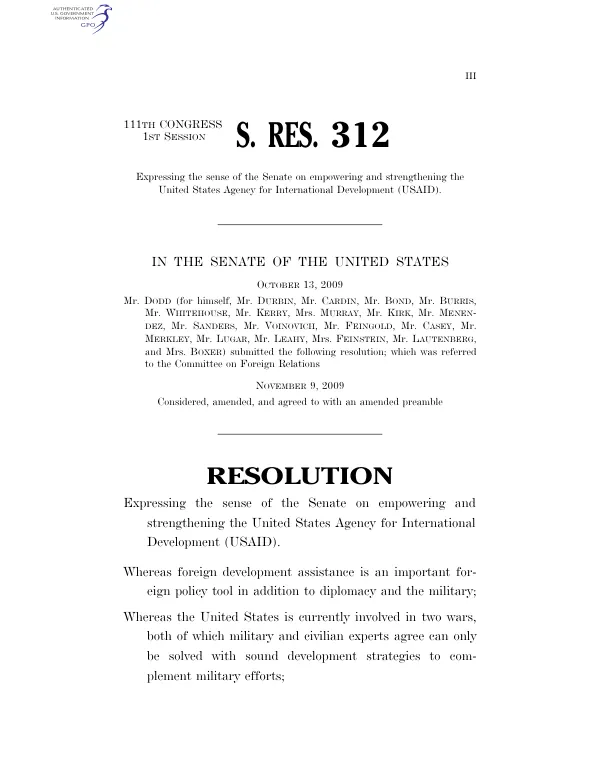
Expressing the sense of the Senate on empowering and strengthening the United States Agency for International Development (USAID)
Sign inUSAID DEC
Expressing the sense of the Senate on empowering and strengthening the United States Agency for International Development (USAID)
The United States Agency for International Development (USAID) plays a crucial role in the country's foreign policy.
2009 · 5 pages
Sign in to readA free account is required to download.
Abstract
Foreign development assistance is an essential tool in addition to diplomacy and the military. The United States is currently involved in two wars, and military and civilian experts agree that sound development strategies are necessary to complement military efforts. Development assistance is a key component of the United States' response to regional conflicts, terrorist threats, weapons proliferation, disease pandemics, and persistent widespread poverty. The 2002 and 2006 United States National Security Strategies included global development as one of the three pillars of national security, alongside the military and diplomacy. USAID's role in this context is critical, as it provides development assistance to more than 150 countries. Historically, USAID had a significant presence, with over 5,000 full-time Foreign Service Officers and 15,000 total staff in its early years. However, by 2008, the agency had significantly reduced its staff, with only slightly more than 1,000 full-time Foreign Service Officers and 3,000 total staff. This decline in personnel and institutional expertise has led to a reliance on outside contractors to manage programs, which has diminished the agency's capacity to provide development assistance. The loss of personnel and expertise has also resulted in a decline in the agency's ability to coordinate and lead foreign assistance programs. Today, more than half of all foreign assistance programs are administered by Federal agencies other than USAID, with funding spread across over 20 United States Government agencies. This has diminished the capacity of USAID and the United States Government to provide development assistance and implement foreign assistance programs effectively. To address these challenges, the Senate has expressed its sense that a highly capable and knowledgeable individual should be nominated to serve as the Administrator of USAID. The Administrator should serve as the chief advocate for United States development capacity and strategy in top-level national security deliberations and as a powerful advocate and effective leader of an empowered USAID. The agency must be empowered to be the primary development agency of the United States, and the Administrator must serve as the principal advisor to the President and national security organs on the capacity and strategy of United States development assistance. The Administrator should also substantially and transparently increase the total number of full-time Foreign Service Officers employed by USAID, in part by reducing the reliance on outside contractor personnel. This would enhance the agency's ability to carry out development activities around the world, strengthen its institutional capacity, and more effectively help developing nations become more stable, healthy, democratic, prosperous, and self-sufficient. The Administrator should submit a strategy to Congress that includes a plan to create a professional training program, a 5-year staffing plan, a description of further resources and statutory changes necessary to implement the proposed training and staffing plans, and a plan to address fraud and corruption in United States development assistance.
Related documents