USAID DEC
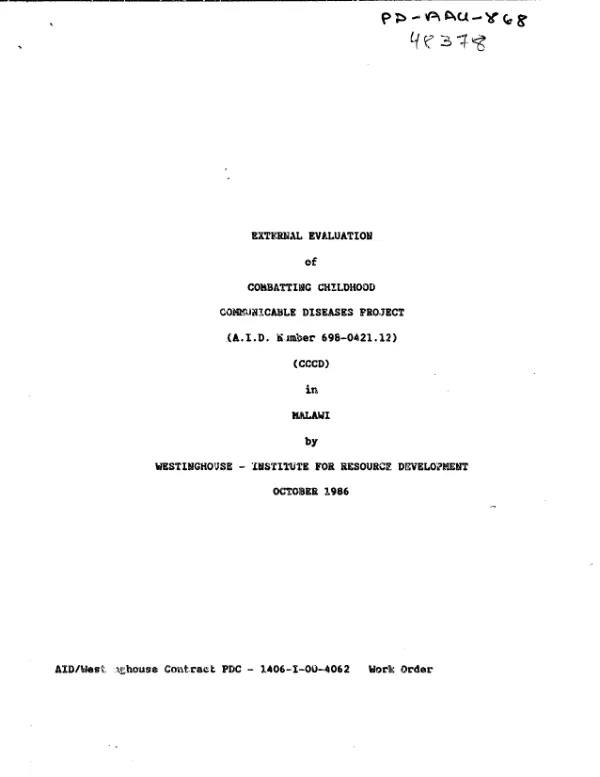
External evaluation of combatting childhood communicable diseases project (AID number 698-0421.12) (CCCD) in Malawi
Sign inWESTINGHOUSE PUBLIC APPLIED SYSTEMS
External evaluation of combatting childhood communicable diseases project (AID number 698-0421.12) (CCCD) in Malawi
Evaluates the Combating Childhood Communicable Diseases (CCCD) project in Malawi.
1986
Sign in to readA free account is required to download.
Abstract
Midterm evaluation covers the period 1984-10/86 and is based on review of project documents and survey data, visits to service facilities and other health institutions, and discussions with project related personnel. While it is impossible to demonstrate if the project has lowered morbidity or mortality among children under five or even (due to the lack of of time-phased plans) to determine progress in improving CCCD coverage, many improvements can be seen in the Expanded Program of Immunization (EPI) and malaria/diarrheal disease control services. Great progress has been made in controlling diarrhea through oral rehydration therapy, now used in all hospitals and taught on an outpatient basis in all Ministry of Health (MOH) units. Mothers are encouraged to use the treatment at home, and a formula for preparing a sugar-salt solution is explained to mothers in clinics. The National Malaria Control Committee was reactivated in 1984 to develop malaria policy; numerous studies have been conducted on the resistance of P. falciparum to chloroquine and on problems of prophylaxis. EPI services have been integrated into the MOH health care network. National 5-year plans (1985-89) for EPI diarrheal disease, and malaria have been published. On the negative side, a shortage of personnel has limited MOH capability to implement CCCD services and forced it to make some individuals responsible for both training and supervision - not always successfully. Permanent training facilities are being built in each national region. Integrated MOH health information systems are being developed; reporting and sample surveys are conducted, and surveillance systems have been established. A major mass media effort is being conducted through A.I.D.'s HealthCom project, although CCCD media efforts may be integrated into - and perhaps submerged in - a proposed centralization of all government media activities. Creation of a health education civil service cadre has been proposed. MOH operations research activities have been extensive and excellent, emphasizing basic areas (e.g., knowledge-attitudes practices, malaria treatment for special populations). Severe weaknesses in supply management, cold chain, and bacterial sterilization exist, but progress is expected in rationalizing the three supply services now used. Financing problems have included MOH failure to submit budget plans, and USAID and MOH failure to pursue cost recovery and provide adequate accounting. As for project sustainability, prospects for the MOH to pay for maintaining CCCD services in the longer run are not promising. Recommendations include a 1-year project extension until 3/31/89.
![[Development Fund for Africa --] impact of child survival activities in Africa : a report on AID's progress in reducing infant and child mortality and illness in 17 child survival priority countries](https://covers.devme.ai/gen/8905.webp)