MOH
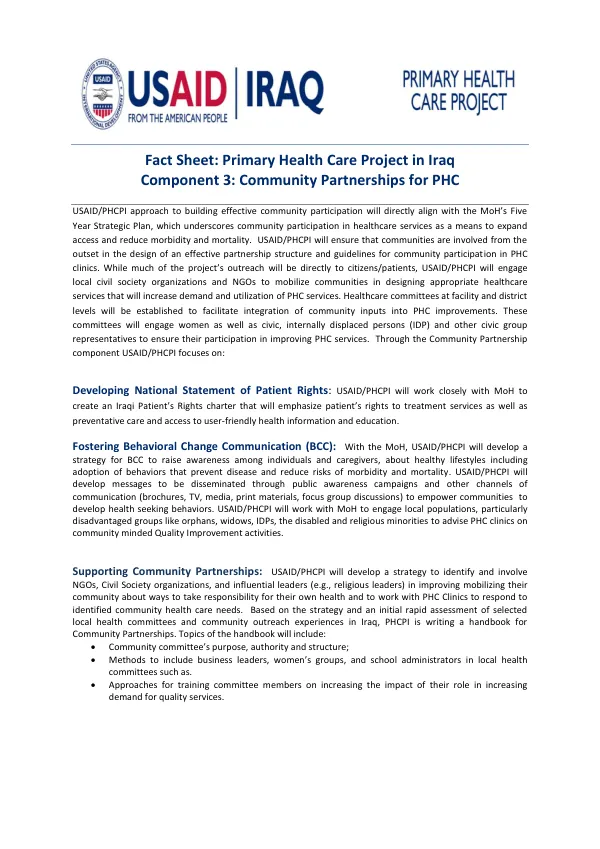
Fact Sheet: Primary Health Care Project in Iraq
The Primary Health Care Project in Iraq focuses on Component 3: Community Partnerships for PHC.
2014 · 1 pages
Sign in to readA free account is required to download.
Abstract
This component aims to build effective community participation in healthcare services, aligning with the Ministry of Health's Five Year Strategic Plan. The plan emphasizes community participation as a means to expand access and reduce morbidity and mortality. Community involvement is ensured from the outset in the design of an effective partnership structure and guidelines for community participation in PHC clinics. Local civil society organizations and NGOs are engaged to mobilize communities in designing appropriate healthcare services that increase demand and utilization of PHC services. Healthcare committees at facility and district levels are established to facilitate integration of community inputs into PHC improvements. These committees engage women, civic groups, internally displaced persons, and other civic group representatives to ensure their participation in improving PHC services. The Community Partnership component focuses on developing a National Statement of Patient Rights, fostering Behavioral Change Communication, and supporting community partnerships. The National Statement of Patient Rights emphasizes patients' rights to treatment services, preventative care, and access to user-friendly health information and education. Behavioral Change Communication is developed in collaboration with the Ministry of Health to raise awareness among individuals and caregivers about healthy lifestyles, disease prevention, and risk reduction. Messages are disseminated through public awareness campaigns, brochures, TV, media, print materials, and focus group discussions to empower communities to develop health-seeking behaviors. Community Partnerships are supported by developing a strategy to identify and involve NGOs, Civil Society organizations, and influential leaders in improving mobilization of their community about ways to take responsibility for their own health. A handbook for Community Partnerships is being written, covering topics such as community committee purpose, authority, and structure, methods to include business leaders, women's groups, and school administrators in local health committees, and approaches for training committee members on increasing the impact of their role in increasing demand for quality services.
Related documents