USAID DEC
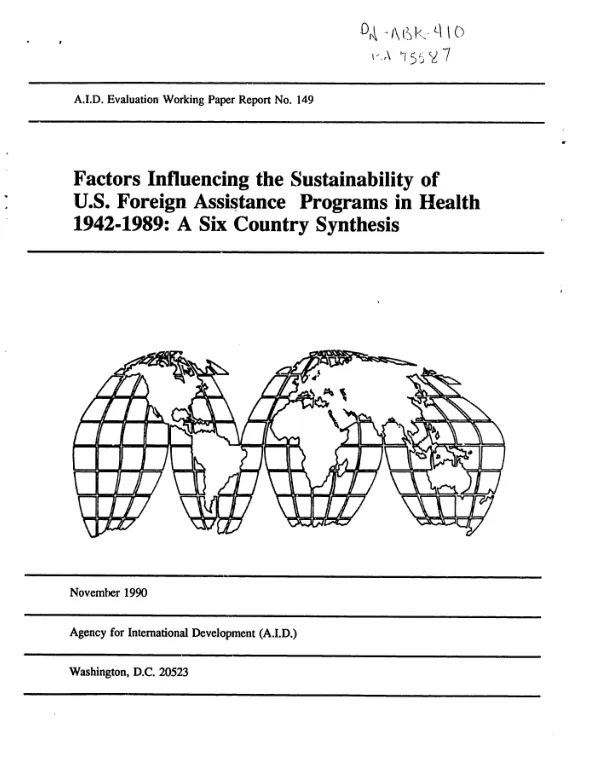
Factors influencing the sustainability of US foreign assistance programs in health 1942-1989 : a six country synthesis
Sign inUSAID. BUR. FOR PROGRAM AND POLICY COORDINATION. CENTER FOR DEVELOPMENT INFORMATION AND EVALUATION (CDIE)
Factors influencing the sustainability of US foreign assistance programs in health 1942-1989 : a six country synthesis
Part of an ongoing USAID effort to assess the sustainability of project activities and benefits after U.S.
1990
Sign in to readA free account is required to download.
Abstract
funding ceases, this study reviews U.S. assistance in health, population, and nutrition programs between 1942 and 1988 in six countries -- Honduras, Guatemala, Senegal, Tanzania, Zaire, and Thailand. The analysis reveals striking differences in the levels of project sustainability within and between countries, between project types, and between regions. In Thailand, many activities were sustained at high levels, while in Central America, significant levels of continuation also existed. In Africa, however, many projects were sustained at much lower levels of activity than during the project life. Health services projects, such as health worker training, clinic construction, and water projects were the most highly sustained in all countries. Malaria projects received an average sustainability score, while nutrition and family planning projects ranked poorly. Contextual factors most closely related to sustainability were the political, economic, and institutional environments, along with national commitment to project goals. Six project characteristics closely related to sustainability were identified: (1) perceived effectiveness; (2) integration into existing institutional hierarchies, (3) established financing, (4) training components, (5) a mutually respectful project negotiation process, and (6) community participation.
Connected topics
Related documents