USAID. MISSION TO HAITI
Factory workers" center (FWC)
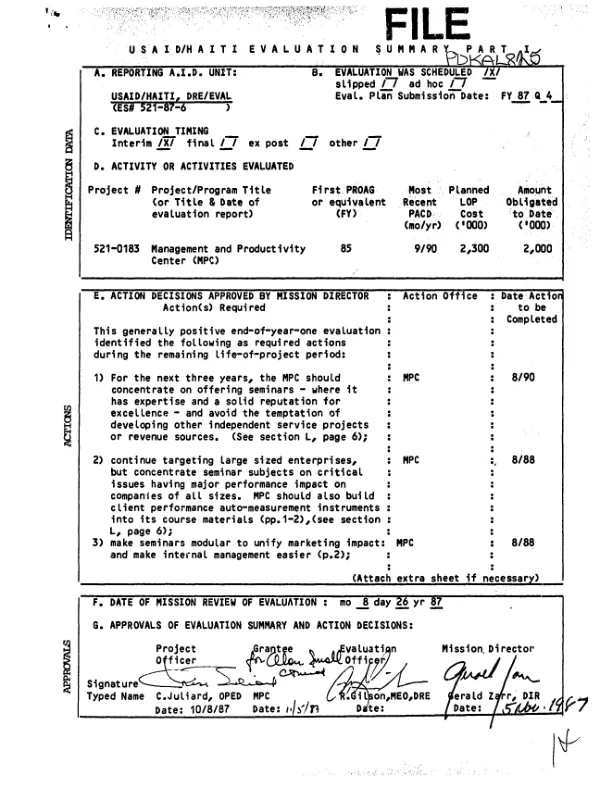
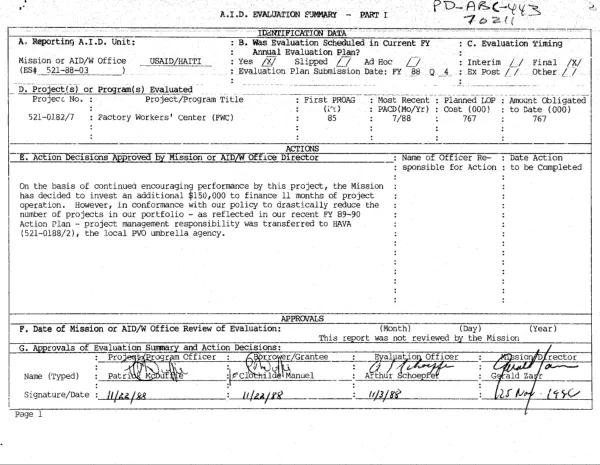
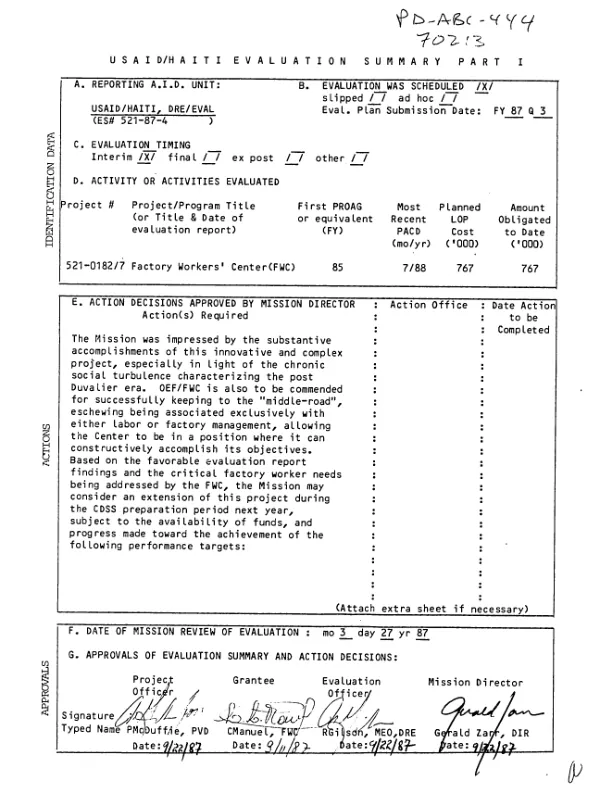
Summarizes external evaluation (XD-ABC-444-A) of a grant to OEF International (8/85-7/88) to establish a Factory Workers" Center (FWC) in Port-au-Prince to improve workers" socioeconomic conditions, promote their self-determination, and increase their productivity.
1987
Sign in to readA free account is required to download.
Abstract
This mid-term evaluation was conducted to ascertain whether or not project objectives were still appropriate in light of the new sociopolitical environment emerging after the overthrow of the Duvalier dictatorship. Evaluation findings are based on interviews with project staff, beneficiaries, factory managers and supervisors, OEF and USAID personnel, and representatives of other agencies. The evaluator also reviewed project files and sat in on several training courses. Project objectives are still sound, i.e., this is not a luxury project, using scarce resources to assist a relatively privileged group of people. Although average factory worker wages may be slightly higher than those of the urban population as a whole, available household income distribution data provide strong evidence that most beneficiary households are poor, even by Port-au-Prince standards, and are not relatively privileged in terms of meeting basic household needs. Operating costs were found to be high because of reliance on comparatively highly paid staff to teach the courses. The cost-effectiveness profile of the FWC should improve considerably with the phased takeover of teaching duties by lower paid monitors. Although literacy was not originally included as a course offerings, widespread illiteracy throughout the target population, coupled with the limited number of adult literacy programs, compelled FWC management to implement a literacy course. Another important factor was the manifest interest of factory managers in having such a service offered to their workers, thereby providing FWC a means of entry into the factories. Unfortunately, the interest and support of factory management for this program falls short of a commitment to absorb part of the operating costs. While it is yet too early to talk about total self-reliance and self-sufficiency, it has already become apparent that the long-term institutional viability of the FWC will be problematic. While both FWC management and the contractor are aware of this problem, actions already taken -- as well as those recommended -- to address this concern in the main are focused on securing grant funds from donor agencies. Experience gained elsewhere in the establishment of service oriented institutions indicates that the Center must put a high priority on generating its own funding resources, through service fees and other charges. One of the lessons to be learned is that persuading factory managers to share costs for services rendered on behalf of factory workers, will be a protracted process. In the meantime, FWC must develop innovative fee-paying mechanisms to increase income, e.g., making its raw data available for sale, upon completion of the baseline study. (Author abstract)
Related documents
Documents in this collection
 1987
1987USAID DEC
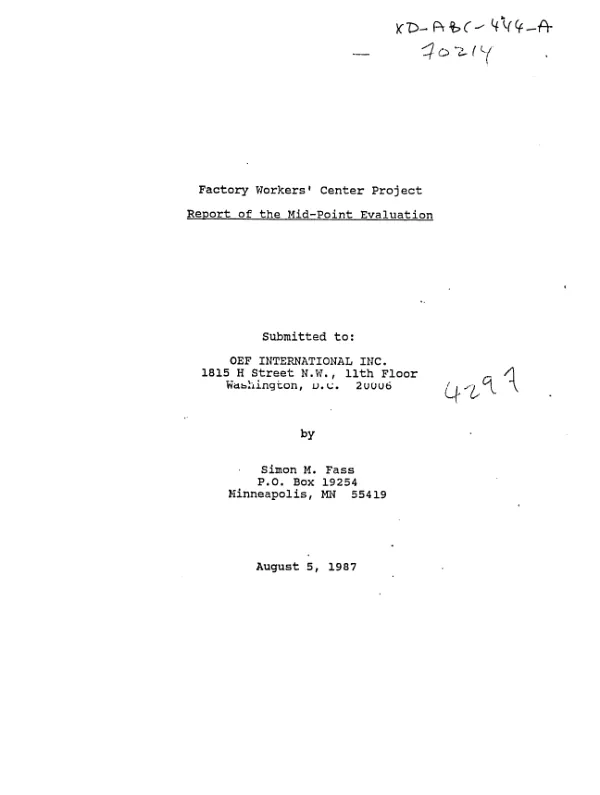
Factory workers' center project : report of the mid-point evaluation
Open record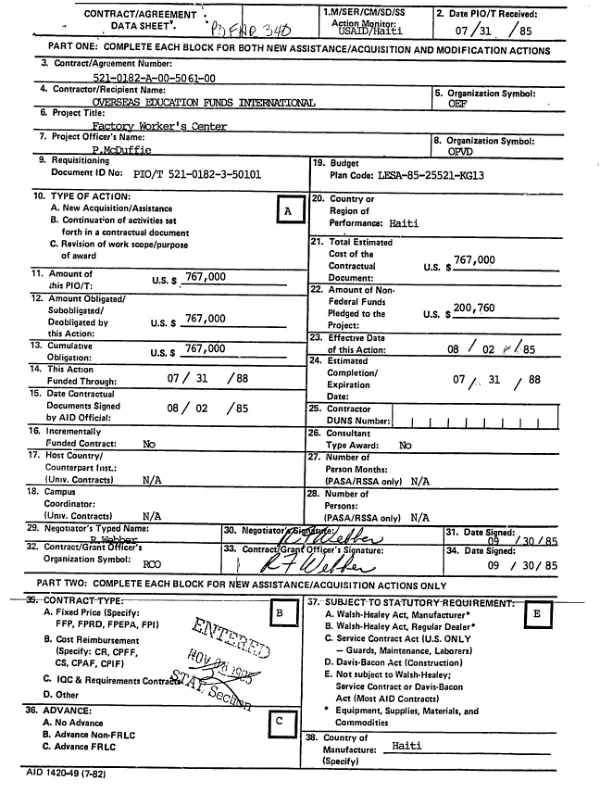 1985
1985USAID DEC