USAID. MISSION TO TUNISIA
Family planning and population development project
Summarizes midterm evaluation of a project to increase contraceptive prevalence in Tunisia.
1989
Sign in to readA free account is required to download.
Abstract
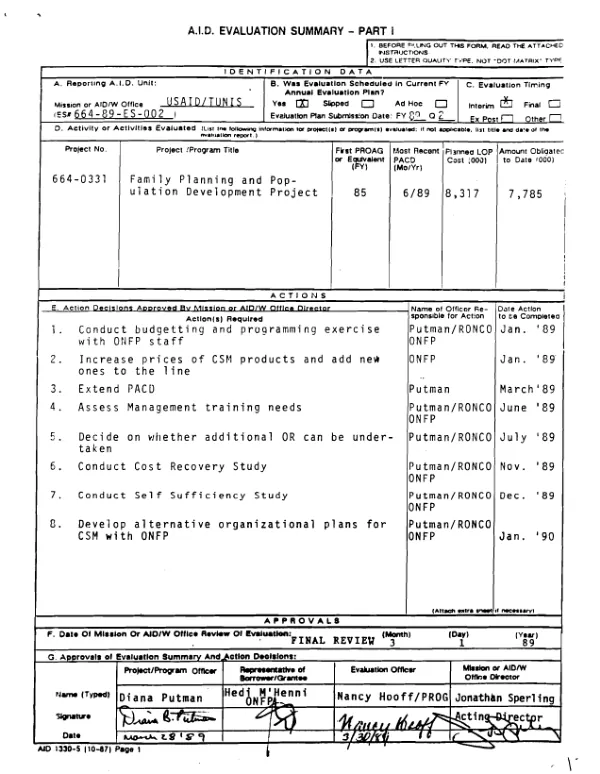
External evaluation covered the period 1985-2/89. Although the project is 18 months behind schedule due to delays in securing the TA contractor, progress has been good overall and the project has already increased contraceptive prevalence by 6.8% (vs. a target of 9%). At the management level, formal collaboration is increasing between the National Family Planning and Population Office (ONFP), the Ministry of Public Health, and Ministry of Social Affairs. In addition, coordination within ONFP has been furthered by the establishment of interdepartmental committees and five interregional training groups. Certain management problems remain, however: the management information system called for in the Pro-Ag has only been partially established; there is difficulty in motivating ONFP staff at all levels to perform at maximum capacity; and ONFP staff have not focused sufficient attention on upgrading skills in priority areas. The pre-service training component is successfully institutionalizing family planning (FP) modules within the professional curricula for social workers, nurses, midwives, and physicians and has been expanded (in a commendable departure from the Pro-Ag) to include post-graduate training for recent graduates in midwifery and nursing. Participant training is on target: two students are receiving long-term training and 15 others have participated in conferences or other short-term exercises. The contraceptive social marketing (CSM) component has: developed a computerized distribution system with medical detailers trained and stationed in five critical locations; developed an active information, education, and communication (IEC) effort, with method-specific promotion in the media and pharmacies; and increased the price of low-dose oral contraceptives, thus improving the prospects for cost-recovery. On the negative side, the proposed CSM unit has neither the staff nor the status to become an effective player within the ONFP. Privatizing the unit is one option ONFP should consider here. In other areas, the formal IEC component has conducted a market survey to assess reactions to FP and conducted two media campaigns; and operational research staff have embarked on four research projects, although the staff is small and beset with many difficulties. The natural family planning program has had certain good effects, but remains apart, refusing to collaborate with ONFP in any form. The main lesson learned is that the idea of self-sufficiency comes hard to an agency that has benefited from donor largesse for over 20 years. A key action decision is to extend the PACD 2 years in order to undertake self-sufficiency and cost-recovery studies.
Related documents
Documents in this collection
![Project assistance completion report [PACR] : family planning and population development, project no. 664-0331](https://covers.devme.ai/gen/24673.webp) 1991
1991USAID DEC
Project assistance completion report [PACR] : family planning and population development, project no. 664-0331
Open record![Midterm evaluation of the PROFAMILIA [Asociacion Pro-Bienestar de la Familia Nicaraguense] diversification, sustainability, and social marketing grant : executive summary](https://covers.devme.ai/gen/72986.webp) 2001
2001USAID DEC
![Project assistance completion report [PACR] : family planning and population development, project no. 664-0331](https://covers.devme.ai/gen/8530.webp)
![Midterm evaluation of the PROFAMILIA [Asociacion Pro-Bienestar de la Familia Nicaraguense] diversification, sustainability, and social marketing grant](https://covers.devme.ai/gen/5467.webp)